
NVIDIA's former chief scientist bought Salesforce again. The pattern matters.
David Blair Kirk's latest near-$1 million purchase followed three earlier additions, bringing verified buying to about $2.87 million.
Anuj Saxena · Founder, TradingEdgeIQ
David Blair Kirk, NVIDIA's former chief scientist and now a Salesforce director, bought almost $1 million of Salesforce shares on September 18. It followed three earlier purchases, bringing the verified total to approximately $2.87 million.
This case shows how repeat buying, purchase size and directly held shares add meaning to one transaction. Previously, Redwood's six-insider pattern examined breadth across people. Next, Seagate's tax-withholding sales shows how a footnote can explain a very different transaction.
Situation: a director's background supplied relevant context
Salesforce appointed Kirk to its board in July 2025. His prior role as NVIDIA's chief scientist makes his technical background relevant to the story. It does not establish his purchase motive, represent NVIDIA's investment view or imply an endorsement of TradingEdgeIQ.
The filing evidence should carry the investment-research argument. The recognizable professional background helps introduce the person whose disclosed activity is being examined.
Complication: the latest purchase was part of a longer sequence
The four purchase records show:
- September 9, 2025: 3,400 shares at $254.655, approximately $865,827.
- December 17, 2025: 1,936 shares at $258.6375, approximately $500,722.
- March 18, 2026: 2,570 shares at $194.6219, approximately $500,178.
- September 18, 2026: 4,176 shares at $239.3321, approximately $999,451.
Those purchases total 12,082 shares and approximately $2,866,178, using reported prices. Gifts and compensation are excluded. The latest purchase was roughly twice the dollar value of each of the preceding two purchases.
The latest filing also shows directly held shares rising from 14,572 to 18,748, an increase of approximately 28.7%. That measures the change in disclosed direct holdings, not the percentage of Kirk's wealth committed or his entire economic exposure.
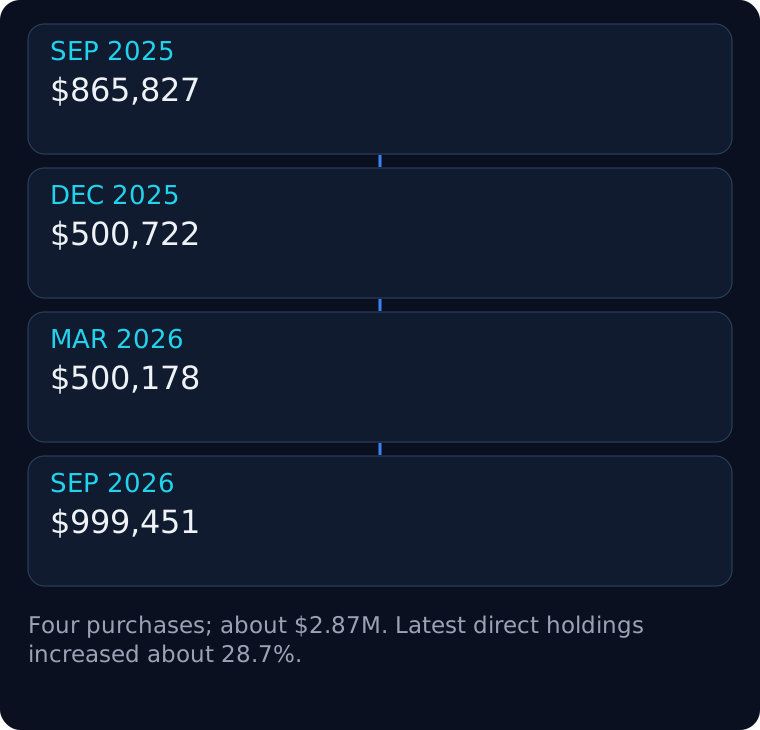
The latest addition is roughly twice each of the previous two. Repetition and the change in direct holdings add context without revealing a complete investment thesis.
Question: what does repeated buying add?
One purchase establishes a transaction. Several purchases across a year show a pattern of additions. Comparing their sizes and ownership effects helps a researcher ask a more focused question about the buyer's exposure and the company being evaluated.
The latest filing became public on September 21 at 6:18:57 p.m. Eastern, after regular trading. Keeping that time separate from the September 18 purchase date prevents a retrospective claim that public researchers knew about the latest addition when it happened.
Price movements do not strengthen this case's central lesson. The useful evidence is the sequence of acquisitions, the larger latest purchase and the increase in directly held shares. Those observations justify investigating Salesforce; they do not establish a target price or Kirk's view of future company performance.
Resolution: compare a person over time
Public Filings Intelligence brings transaction details, ownership information and original filings together. Researchers can spend less time finding evidence and more time evaluating what the repeated activity adds to their research.
For this case, the source-based comparison is explicit about what it counts: four verified purchases, their reported prices and the latest direct-holdings change. It does not claim that the product inferred Kirk's motives, sent a historical alert or automatically generated the whole comparison.
What this proved
Kirk's nearly $1 million purchase is more informative alongside the three earlier additions. The sequence makes persistence and changing purchase size visible, while the holdings comparison puts the latest transaction in context. That is a stronger foundation for deciding what to investigate than a celebrity-background headline alone.
Return to Redwood's six-insider pattern to compare breadth with persistence. Continue to Seagate's tax-withholding sales to examine why even a nine-figure sale needs its transaction explanation.
Image credit
Cover: Christopher Michel, "Sales Force Tower", July 13, 2019, CC BY 2.0. Cropped and resized. Archival company context; no portrait or endorsement implied.
Research and analytics only. No auto-trading. No financial advice. Historical and simulated results do not guarantee future performance.
Related