
Six Redwood Trust insiders bought in one week. What deserves a closer look?
About $969,000 of purchases across six insiders creates a focused research question about earnings, housing finance and book value.
Anuj Saxena · Founder, TradingEdgeIQ
Six Redwood Trust insiders purchased approximately $969,000 of shares between September 15 and September 21. The breadth of buying makes the company worth investigating, while its latest quarterly results identify the questions that investigation should address.
This article connects the distinct purchasers with earnings and book-value context, and explains why an amendment must not become an extra purchase in the count. Previously, the prop-firm challenge case tested a strategy against specific constraints. Next, David Kirk's Salesforce purchases compares buying across time by one person.
Situation: operating volume and consolidated results diverged
Redwood finances housing through mortgage banking and investments. Its second-quarter results reported more than $8 billion of mortgage banking production. Book value per common share declined from $7.12 to $6.90.
Consolidated non-GAAP earnings available for distribution were $0.15 per share, compared with an $0.18 dividend. Core-segment EAD was separately reported at $0.25. Those two earnings measures have different scopes and should not be substituted for each other. One quarter's consolidated comparison also does not establish that the dividend is unsustainable.
Complication: the purchase pattern spanned six people
The company's Section 16 filings show purchases by CEO Christopher Abate, President Dashiell Robinson, CFO Brooke Carillo, board chair Greg H. Kubicek, chief legal officer Andrew Stone and chief human resource officer Sasha G. Macomber during the September 15–21 period. Names and roles are also confirmed by Redwood's leadership page.
Calculated from their reported shares and prices, the approximate values were $383,900 for Abate, $251,580 for Robinson, $192,560 for Kubicek, $100,238 for Carillo, $20,594 for Stone and $19,968 for Macomber. The total is approximately $968,840. These figures describe six identified purchasers, rather than a count of every row or form.
Abate's September 18 amendment corrected ownership information. It is not an additional purchase and must not be counted again. The transaction code identifies purchases, but this article does not infer open-market execution from Code P alone.
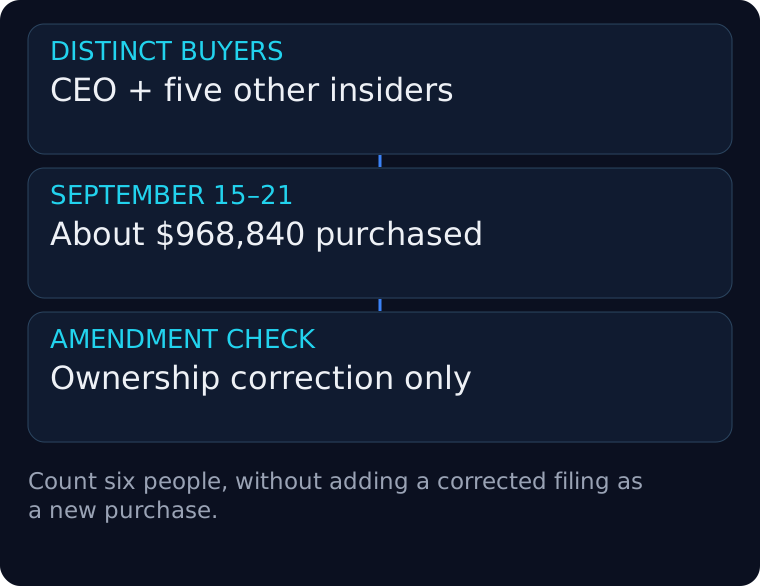
Breadth comes from distinct purchasers. Counting a corrected filing as another acquisition would inflate the evidence. Dollar values are calculated approximations.
Question: what should that breadth lead an investor to examine?
Buying across several roles supplies a more substantial reason to investigate than one isolated purchase. The research question is whether the business evidence supports the confidence an investor might infer from that activity, and which risks remain visible in earnings and book value.
That means examining how mortgage production converts into earnings, how valuation changes affect the investment portfolio, and how different earnings measures relate to distributions. Purchase breadth cannot answer those questions by itself. It helps identify the company as a candidate for the work.
The distinction between evidence and inferred motive is important. The forms disclose acquisitions, not a collective management statement about future results. Calling them a coordinated decision would add a claim the filings do not support.
Resolution: preserve the cluster and the contrary evidence
Public Filings Intelligence organizes transaction details, ownership information, amendments and original sources. It helps reduce the time required to gather and reconcile records before evaluating the business context.
For Redwood, a useful research record contains six purchasers, one correctly handled amendment and the mixed quarterly results. Keeping both purchase breadth and operating risks visible supports a better-informed decision about whether to continue researching. This six-person aggregation is editorial source analysis, not a claim that the platform automatically generated this exact cluster or issued a historical alert.
What this proved
Redwood's purchase pattern earns attention because it spans six people in a short period. Its significance depends on accurate counting and the business context that follows. The next useful step is to test an investment thesis against earnings and book-value evidence, rather than treating the buying as a promise of recovery.
Return to the prop-firm challenge case for another example of making constraints explicit. Continue to David Kirk's Salesforce purchases to compare six buyers in one week with one buyer's repeated additions over a year.
Primary purchase records
Image credit
Cover: housing photograph from PxHere, CC0, cropped and resized. Generic housing-finance illustration, not an identified Redwood property or investment.
Research and analytics only. No auto-trading. No financial advice. Historical and simulated results do not guarantee future performance.
Related