Seagate insiders sold $114 million. The footnotes explain why.
The CEO and CFO's reported sales followed performance-share settlements and were issuer-mandated to cover tax withholding.
Anuj Saxena · Founder, TradingEdgeIQ
Seagate's CEO and CFO sold approximately $114.18 million of stock on the same day. Both filings explain that the sales were company-mandated to cover tax withholding after performance-share awards settled.
This article shows why the transaction explanation must accompany the dollar amount. Previously, David Kirk's Salesforce purchases examined repeated buying. Next, the small-parameter-change case asks whether an attractive strategy result survives a change in assumptions.
Situation: awards settled before shares were sold
The CEO's Form 4 and CFO's Form 4 describe performance-share awards settling into ordinary shares on September 14, 2026. The reported sales followed on September 15.
William D. Mosley's award settlement involved 177,000 shares. Gianluca Romano's involved 90,380. Reading the settlement and sale together establishes the transaction sequence that the headline leaves out.
Complication: the sale amount invites a different interpretation
CEO Mosley sold 97,889.25 shares at a reported weighted-average price of $772.1432, approximately $75,584,519. CFO Romano sold 49,983.5 shares at $772.1573, approximately $38,595,124. Together, the calculated gross value is approximately $114,179,643. It is not net proceeds after taxes or fees, or a total for all Seagate insiders.
Footnote 2 in each filing identifies issuer-mandated sales solely to cover tax withholding. The award-related entries and footnotes supply the reason those shares were sold. These disclosures therefore do not establish two independent decisions to reduce exposure because of a negative view of the business.
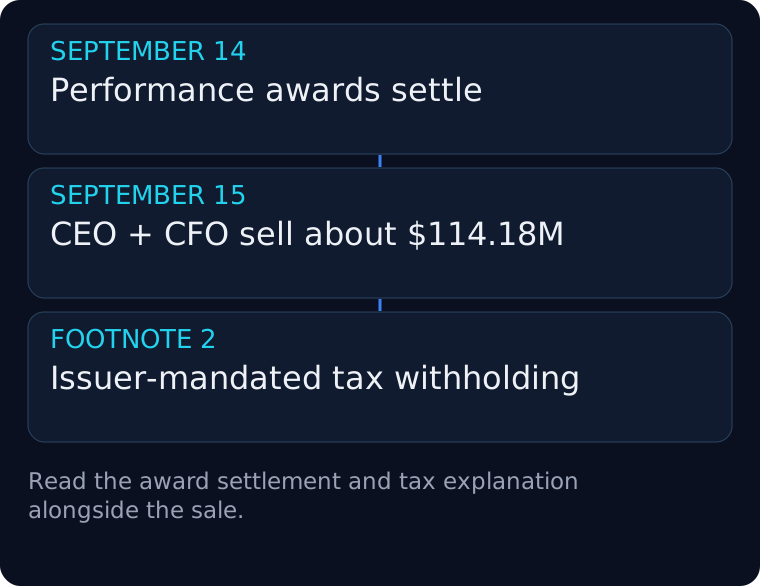
Two officers met the same type of tax obligation after awards settled. The disclosed explanation changes how the combined sale amount should be interpreted.
Question: what does the form actually demonstrate?
It demonstrates the reported award settlements, subsequent sales and the stated tax-withholding mechanism. Those facts are enough to correct the assumption that the dollar amount necessarily represents discretionary bearish sentiment.
They do not settle the separate investment question of whether Seagate is attractive. That requires business, financial and valuation research. Adding a short-term price chart would not establish the purpose of these particular sales, so the case keeps its attention on the evidence that answers the question.
The transferable method is straightforward: identify the transaction immediately before the sale, read the numbered footnotes and determine whether the sale was discretionary, planned or required. If the filing supplies a specific explanation, preserve it instead of allowing a generic sale label to carry the conclusion.
Resolution: bring the explanation into the research record
The CEO record and CFO record in TradingEdgeIQ connect the reported transactions with holdings, original footnotes and SEC links. Public Filings Intelligence reduces the manual work of assembling those facts so the researcher can spend more time interpreting them.
The efficiency comes from finding the detail that changes the question. It does not depend on predicting a price move or automatically assigning a motive beyond the filing. The tax explanation in this article comes directly from the original source footnotes.
What this proved
Two large sales can share a transaction mechanism without forming a bearish cluster. Here, award settlements preceded mandatory tax-withholding sales. Reading the forms as connected events produces a more accurate interpretation than summing their sale amounts alone.
Return to David Kirk's Salesforce purchases for the buying pattern. Continue to the small-parameter-change case to see why the assumptions surrounding a result matter as much as the result itself.
Image credit
Cover: LPS.1, Seagate Technology Headquarters Cupertino, April 6, 2013, CC0. Cropped and resized. This is an archival photograph of a former headquarters, not current headquarters imagery or contemporaneous footage of the transactions.
Research and analytics only. No auto-trading. No financial advice. Historical and simulated results do not guarantee future performance.
Related