
Nayax fell about 20%. Then its CEO bought $4.6 million.
Yair Nechmad's purchase and David Ben-Avi's smaller additions create a two-insider research pattern against a mixed growth and cash-flow backdrop.
Anuj Saxena · Founder, TradingEdgeIQ
Nayax's Nasdaq closing price fell about 20.7% between September 2 and September 23. The next day, CEO, co-founder and chairman Yair Nechmad purchased approximately $4.61 million of shares. A second co-founder had also been buying.
This case shows why the CEO's purchase becomes more useful when it is connected with another insider's activity and the company's recent operating context. Previously, profitable on paper, fragile in reality examined the evidence behind a strategy result. Next, CrowdStrike's eight sale rows shows why several rows do not always mean several independent signals.
Situation: growth and cash-flow expectations told different stories
Nayax provides cashless payment and related commerce technology. Its second-quarter results, released August 10, reported revenue of $122.6 million, up 28.2% year over year. The company recorded a $10.1 million net loss, including $12.4 million of noncash stock compensation.
The same release revised expected full-year free-cash-flow conversion from adjusted EBITDA from approximately 40% to 5%–10%, citing accelerated growth investment. Revenue and adjusted EBITDA outlooks were reaffirmed. Strong revenue growth and a lower cash-conversion expectation can coexist, so a research review needs both.
Complication: the stock declined before two founders added shares
Daily price data show a $53.75 close on September 2 and $42.63 on September 23. The 20.7% decline refers to those two closing prices. It is not a year-to-date return or a claim that the earnings release caused every part of the move.
Nechmad's September 24 Form 4 transaction reports 104,511 shares at a disclosed dollar price of $44.0884. The calculated value is approximately $4,607,723. Its footnote confirms an open-market purchase paid in Israeli shekels. The table already reports a US-dollar price, so applying a second currency conversion would distort the amount.
CTO and co-founder David Ben-Avi's filings show smaller purchases: 1,014 shares on September 17, followed by 1,554, 700 and 100 shares on September 22, 23 and 24. His 3,368 shares total approximately $144,975 using the reported prices. The purchase footnotes identify open-market transactions.
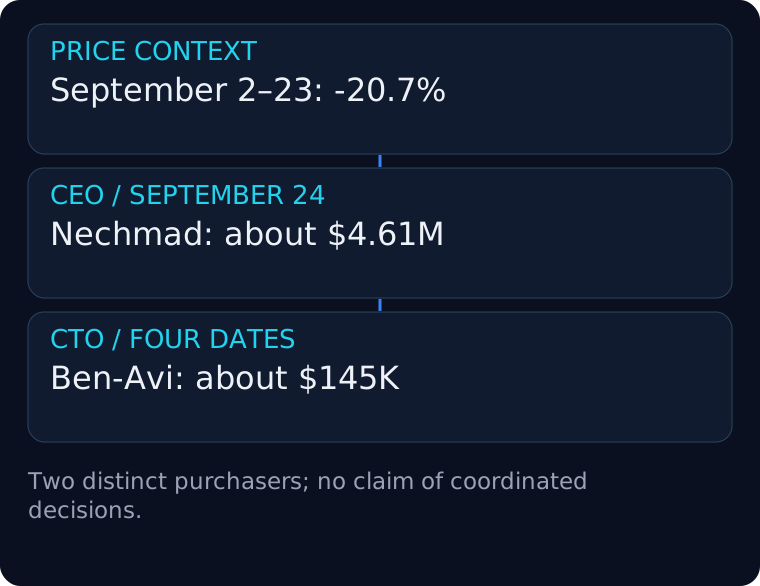
Two distinct purchasers add breadth to the evidence. Their purchases differ greatly in size, and the filings do not establish coordination or a future price recovery.
Question: what makes this a useful research signal?
The CEO's purchase is large enough to earn attention on its own. The CTO's repeated additions supply another observation from a different reporting person. Reading them together helps a researcher avoid overlooking activity that would appear small beside the CEO's headline amount.
That creates a practical question: do the company's growth prospects justify the investment spending and lower near-term cash conversion? The insider purchases help focus the research queue. The operating release identifies what should be examined inside that queue.
An investor would still need to evaluate margins, cash generation, funding needs and valuation. Neither executive's filing discloses a complete investment rationale. Subsequent price movements also cannot retrospectively establish what either buyer knew or intended.
Resolution: use clustering to organize the investigation
Public Filings Intelligence organizes transaction details and source-linked context, reducing the manual work required to find relevant filings and compare their contents. In this example, the researcher can connect activity by two insiders, check the purchase footnotes and then consult the business results.
The benefit is research efficiency: less time finding and reconciling records, more time deciding whether the evidence deserves a deeper review. The complete two-founder comparison here is editorial analysis. We do not claim a historical TradingEdgeIQ alert, a particular Signal score or an automatically generated investment conclusion.
What this proved
Nayax offers a stronger case than a single large purchase headline. Two founders bought during the same recent period, while the business reported fast revenue growth and revised cash-flow expectations. Keeping those facts together produces a clearer research question without turning insider buying into a price forecast.
Return to profitable on paper, fragile in reality for another example of testing an attractive headline against its supporting evidence. Continue to CrowdStrike's eight sale rows to see how ownership structure changes the apparent breadth of insider activity.
Image note
The cover is an AI-generated cashless-payment illustration retained from the approved video assets. It does not depict an actual Nayax device, a company site or an executive. There are no added titles, subtitles or labels.
Research and analytics only. No auto-trading. No financial advice. Historical and simulated results do not guarantee future performance.
Related