
Insider buying vs. selling: what the filing can actually tell you
Compare insider purchases and sales using transaction codes, ownership changes and source footnotes. Learn which questions to investigate before drawing a conclusion.
Anuj Saxena · Founder, TradingEdgeIQ
An insider purchase can give you a reason to investigate. A sale can do the same. The first useful question is what caused the ownership change.
This guide compares the research questions raised by buying and selling, then applies them to a real filing. Previously, how to read SEC Form 4 established the reading method. Next, evaluating insider buying clusters takes that method across several disclosures.
Transactions add evidence to company research
An ownership disclosure gives a researcher a concrete event to examine. The person's role, transaction size, security, resulting holdings and prior activity can help determine what deserves a closer look.
The SEC's investor bulletin specifically notes that sales can have several reasons, including liquidity and diversification. A sale label does not establish the seller's outlook.
Acquisitions and dispositions have different mechanisms
An acquisition may reflect a purchase, an award, an exercise, a conversion or a transfer. A disposition can reflect a sale, a gift or another movement. Even a code-S sale may have an explanation that changes how a reader interprets it.
In Seagate CFO Gianluca Romano's September filing, 90,380 ordinary shares were acquired when performance-share units settled. The next day, 49,983.5 shares were sold. Footnote 2 identifies issuer-required tax withholding as the reason for the sale.
The lesson is to record the explanation actually supplied by the filing. A general explanation such as diversification remains a possibility until a source supports it for that particular transaction.
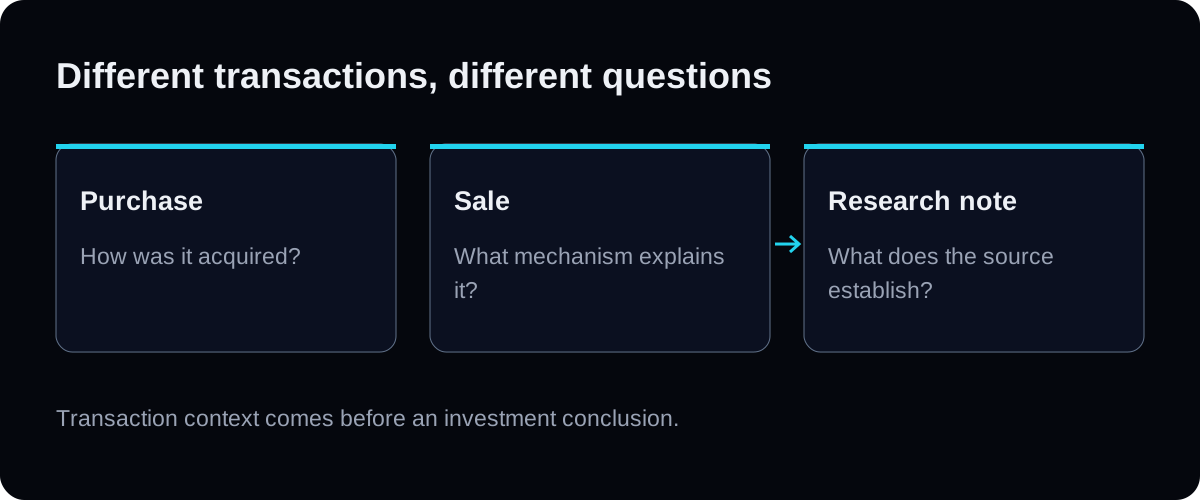
A transaction's direction starts the investigation. Its mechanism and ownership context determine the next useful question.
What should a researcher compare?
For a purchase
- Does the filing describe an open-market or private transaction?
- What did the insider acquire: ordinary shares or a derivative instrument?
- How does the position change within the reported ownership context?
- Is this a one-off event, repeated activity by the same person, or part of activity by several people?
- What do the source footnotes add about the transaction's terms?
For a sale
- Does the filing state a purpose or transaction mechanism?
- Did an award settlement or exercise occur alongside it?
- Does the disclosure identify a Rule 10b5-1 arrangement?
- How much of the reported holding remains, within the same security and ownership form?
- Are several rows parts of one event rather than independent decisions?
These are a research checklist, not a scoring formula. Apply them consistently to purchases and sales before comparing companies.
Compare explained transactions
Write a short account of the event, the ownership change and the source explanation. Then identify the company question it raises. For a discretionary purchase, that might concern the buyer's increased exposure. For an award-related sale, the question may concern compensation and resulting holdings.
Bring financial performance, valuation and business risks into the next stage of research. A clear ownership record gives that work a focused starting point.
TradingEdgeIQ's Public Filings Intelligence helps organize the disclosures and their source context. The sample report shows the type of evidence to carry into the next research decision.
The takeaway
Buying and selling both become more useful when the transaction mechanism is understood. The Seagate filing demonstrates why a sale and an award settlement should be read together. A company conclusion requires the wider business context.
Return to how to read SEC Form 4 for the source-reading sequence. Continue to evaluating insider buying clusters to examine whether several disclosures add independent evidence.
Sources
Research and analytics only. No auto-trading. No financial advice. Historical and simulated results do not guarantee future performance.
Related