
Two Upstart Filings. One Bullish-Leaning Picture.
Upstart's CEO made a $1.28 million open-market purchase near recent support. A second filing showed an option exercise and partial sale. Read why the two signals carry different weight.
Anuj Saxena · Founder, TradingEdgeIQ
Different transaction types. Different signal strengths.
Previous: Contract Win. Time to Buy? explains how to assess another kind of research lead.
Next reading: Six Angel Studios Purchases, One Sustained Pattern connects repeated purchases across several filings.
Two Upstart Holdings insider filings became public on September 10, 2026, only 69 seconds apart. A quick scan might reduce them to one purchase and one sale.
That summary would miss the most useful part of the story.
One filing showed Chief Executive Officer Paul Gu making a discretionary open-market purchase worth about $1.28 million. The other showed company president Sanjay Datta exercising options and then selling part of the shares received. The price chart added another piece of context: Gu's purchase occurred after UPST had declined into the lower end of its recent range.
What should a researcher infer when the two records are viewed together?
The evidence supports a bullish-leaning interpretation, led by the CEO's open-market purchase and supported by Datta's net increase in reported common shares. The two disclosures do not carry equal weight, and neither predicts what the stock will do next.
The CEO bought 50,000 shares in the open market
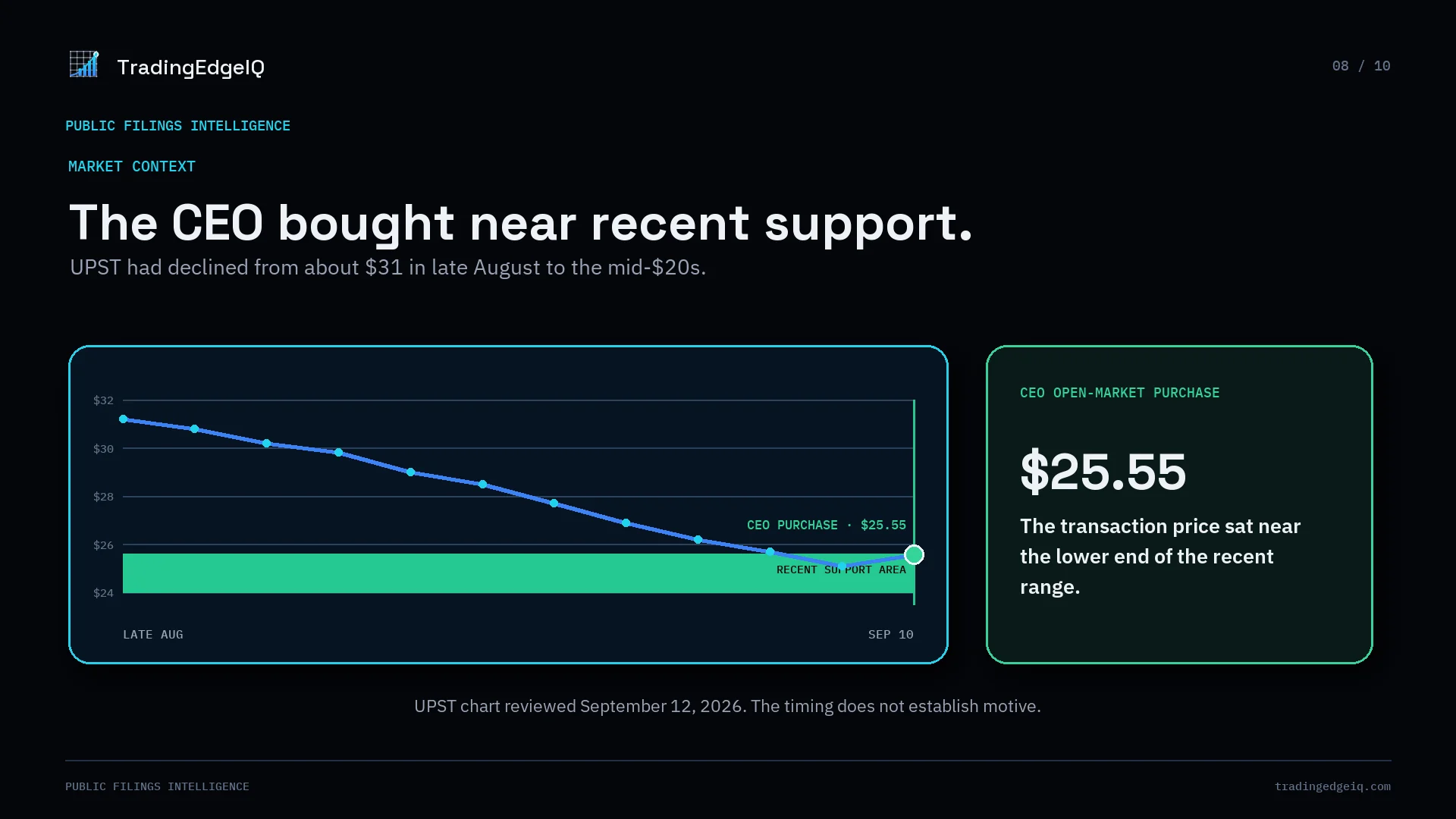
Paul Gu reported buying 50,000 Upstart shares on September 10 at a weighted average price of $25.55 per share. The calculated value was $1,277,500, shown here as about $1.28 million. Paul Gu’s Form 4.
The filing became public later that day at 6:13:30 PM Central Time.
TradingEdgeIQ's Public Filings Intelligence solution assigned the event an Activity Relevance score of 81 with High Evidence Confidence. The score placed the record high in a research queue. It was not a price forecast.
Why the CEO purchase scored 81
Four facts raised the research priority:
- The transaction was a discretionary open-market purchase.
- The buyer was Upstart's chief executive officer.
- The calculated value was about $1.28 million.
- The comparable holding reported through JECCO LLC increased from 80,000 to 130,000 shares, a 62.5% increase.
The 62.5% increase refers to the comparable JECCO LLC holding, not all of Gu's Upstart holdings. Other holdings were reported separately.
High Evidence Confidence answers a different question from the score. It means the filing clearly supported the company, person, role, transaction, price, and ownership details used in the analysis.
The second filing required different context
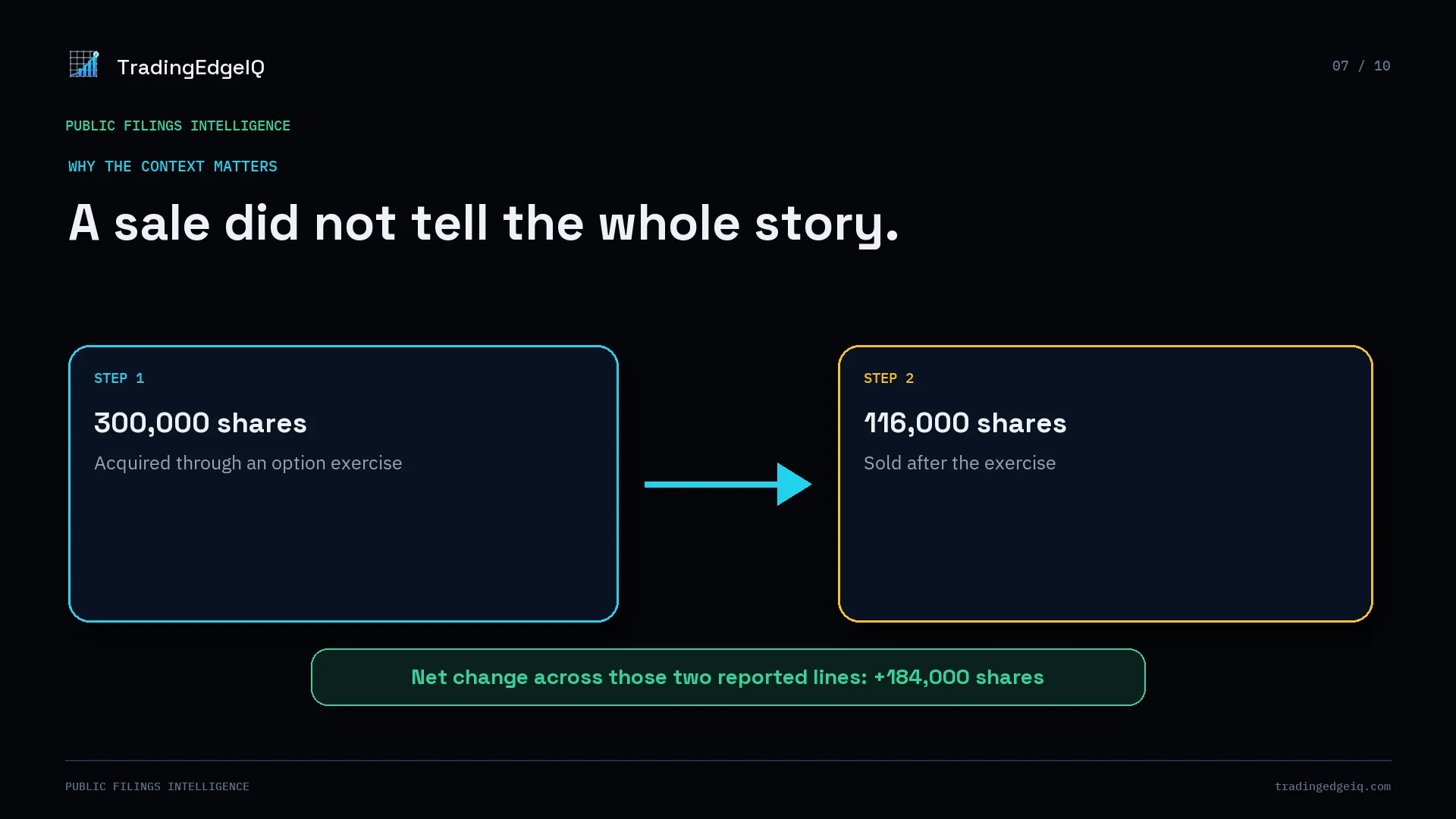
Sanjay Datta, Upstart's President of Capital & Enterprise, reported activity from September 8. He exercised options for 300,000 shares and then sold 116,000 shares at a weighted average price of about $27.29. The sale value was about $3.17 million. Sanjay Datta’s Form 4.
Across the two reported transaction lines, Datta acquired 300,000 shares and sold 116,000, resulting in a net increase of 184,000 shares.
That net increase is constructive ownership evidence. It is weaker than Gu's fresh open-market purchase because Datta's shares came from an option exercise, a compensation-linked event, before the partial sale.
Datta's filing became public at 6:12:21 PM Central Time. Gu's filing followed at 6:13:30 PM, only 69 seconds later.
The price chart strengthened the context
The daily and hourly UPST charts reviewed on September 12 showed the stock declining from roughly $31 in late August into the mid-$20s. Recent price reactions placed a practical support area around $24 to $25.50. Gu's disclosed purchase price of $25.55 sat near the upper edge of that area and near the lower end of the recent range.
This timing is consistent with a constructive interpretation. It does not prove that Gu bought because he expected the stock to rise. Datta's option exercise occurred two days earlier and should not be described as a discretionary purchase at support.
The chart also shows why “the bottom” would be too strong. UPST had traded below this area over the longer period. “Near recent support” describes the observed evidence more accurately.
The combined interpretation
Taken together, the disclosures lean bullish:
- Primary signal: Gu committed about $1.28 million to a discretionary open-market purchase near recent support.
- Supporting signal: Datta retained 184,000 of the shares acquired through his option exercise after selling 116,000.
- Shared result: Both executives increased their reported common-share holdings across the disclosed lines.
- Difference in strength: Only Gu made a fresh open-market purchase.
A researcher should treat this as a reason to investigate UPST further, not as a stand-alone instruction to buy. The useful question is how the filings, price context, company fundamentals, valuation, and broader market conditions fit together.
Why the 69-second gap matters
The short gap did not make the transactions related. It made them easy to encounter together.
A simple feed could show one purchase and one sale without explaining what created either record. TradingEdgeIQ preserved the context behind each one:
- Who reported the transaction
- The person's role at the company
- Whether the activity was an open-market decision or option-related
- The number of shares acquired and sold
- The resulting ownership change
- When the transaction occurred and when the filing became public
- The original SEC evidence
Context comes before conclusion
The Upstart filings show how several layers of evidence can strengthen a research interpretation without becoming a prediction. Transaction type established the relative signal strength. Ownership changes clarified what remained after the sale. The price chart showed that the CEO purchase occurred near recent support.
TradingEdgeIQ's Public Filings Intelligence solution helps researchers find the records that deserve attention and keep the evidence close to every score.
Explore Public Filings Intelligence
Discover 🔷 Analyze 🔷 Simulate 🔷 Decide
Research and analytics only. No auto-trading. No financial advice.
Previous: Contract Win. Time to Buy? explains how to assess another kind of research lead.
Next reading: Six Angel Studios Purchases, One Sustained Pattern connects repeated purchases across several filings.
Sources
- Paul Gu Form 4 filing
- Sanjay Datta Form 4 filing
- Upstart investor relations SEC filings
- UPST daily and hourly charts supplied by the owner and reviewed September 12, 2026; copies retained in the campaign evidence folder
Filing facts were rechecked against Upstart's official filings and SEC submission records before publication. Price context reflects the charts reviewed September 12, 2026. The cover is an illustrative fintech scene and does not depict either executive.
Research and analytics only. No auto-trading. No financial advice. Historical and simulated results do not guarantee future performance.
Related