
Contract Win. Time to Buy? How Investors Can Read Government Contracts
A government contract can support an investment thesis, but the amount alone is not enough. Learn what makes a useful research lead and how TradingEdgeIQ scores contract activity.
Anuj Saxena · Founder, TradingEdgeIQ
A company appears beside a multimillion-dollar government contract. Is that a reason to buy the stock, or a reason to investigate?
A meaningful award can strengthen an investment thesis. The useful interpretation depends on what the government committed to, how the action changes the company's business, and what investors already expect.
Our previous article, AXON: What Were Federal Agencies Buying?, connected lobbying themes with federal purchasing. Here, we examine the individual contract record and the score attached to it. For the next research comparison, Two Upstart Filings. One Bullish-Leaning Picture. shows how the same habit of checking context applies to insider disclosures.
The video above introduces the workflow. This article explains the distinctions behind it: contract activity can be useful business evidence; a research score helps prioritize that evidence; an investment decision still requires an assessment of business impact and valuation.
Why the dollar amount can mislead
Government purchasing records can describe a new commitment, an additional order, a modification, or a funding adjustment. A large amount is worth examining, but it does not automatically mean that the company has just received that amount in cash, earned it as revenue, or generated an equivalent profit.
The sign of the amount also needs context:
- A positive amount can indicate additional obligated funding. Check the specific action and its terms before calling it a new contract win.
- A negative amount can indicate a funding reduction. That might reflect a change in scope, but it can also reflect removal of unused funds during contract closeout.
- A zero amount can accompany an administrative update without a new financial commitment.
Federal contract closeout provisions explicitly allow unused funds to be removed. That is one reason to inspect the description before treating every negative action as bad news for the business. Federal acquisition reference.
Start with a real record
The example in the video is a Palantir-linked record with a reported amount of $20,439,958:
- Company in the product: Palantir, observed ticker PLTR.
- Recipient in the official award: Palantir USG Inc.
- Agency: U.S. Department of State.
- Recorded purpose: An order described as electronic health record and Axiom work under a blanket purchase agreement.
- Action date in the product record: August 24, 2026.
- Announcement date in the product record: August 26, 2026.
The official USAspending award identifies the recipient and purpose and reports total obligations of $20,439,958 when checked for this article.
The two product dates serve different purposes. The announcement date is the date supplied in the provider record; it is not presented here as the first instant the federal government published the award. The contract's performance period is another separate field.
This record provides a concrete starting point: a named recipient, agency, amount, and purpose. To determine the investment significance, the researcher still needs to examine the award history, funding terms, delivery period, and importance to the company's overall business. We have not assigned an illustrative score or assumed that this particular action represents entirely new work.
What makes a stronger research lead?
The following distinctions are a practical reading guide, not automated grades currently assigned by TradingEdgeIQ.
Stronger lead: clear new business with meaningful scale
A record deserves closer attention when the evidence establishes meaningful additional work, clear funding, and understandable delivery terms. A new customer, a broader deployment, or additional recurring services may add to the business case when the source records support those conclusions.
The key question is: Could this change what I expect from the company's future business? A contract that matters to a smaller company may have little financial significance for a much larger one.
Routine activity: useful continuity, limited new information
Repeat orders, expected renewals, and small extensions can confirm that a customer relationship continues. They may still matter when viewed as a pattern. An individual action may add little new information if it was already expected or small relative to the company.
The question becomes: Does the sequence reveal a change that one routine order would not?
Unclear record: investigate before interpreting
A missing description, unclear recipient relationship, or unexplained funding adjustment makes the business meaning harder to assess. A large number cannot fill those gaps.
The next step is to open the original award and its history. An unclear record is a limitation of the available evidence, not a judgment that the company is poor quality.
Does TradingEdgeIQ assign a score?
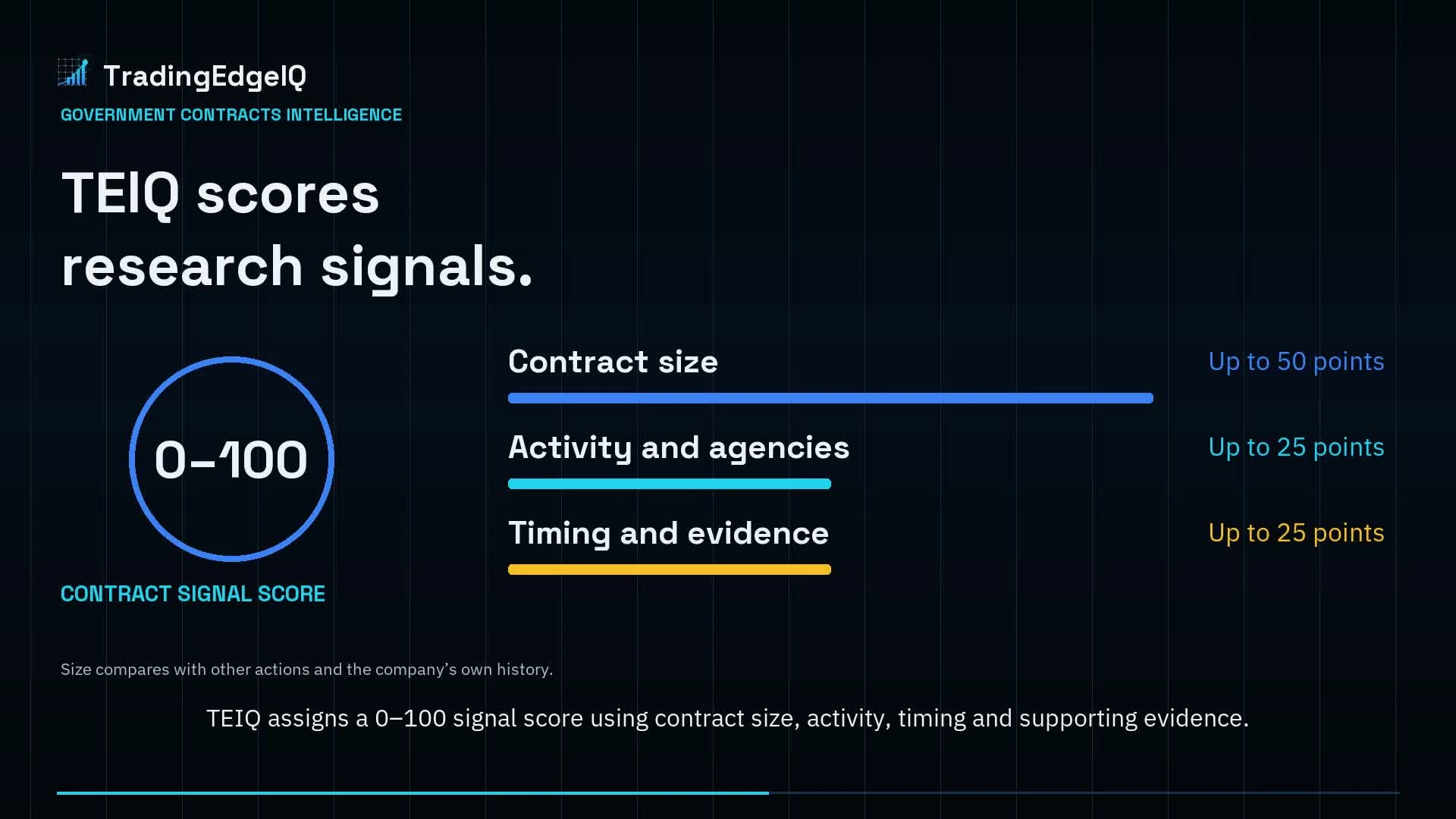
Yes. Government Contracts Intelligence uses a score from 0 to 100 to prioritize contract activity for research. The current model evaluates several characteristics of the record and its available history:
- Size compared with other companies' recorded actions: up to 30 points. How large is the absolute amount within the available comparison set?
- Size compared with the company's own recorded actions: up to 20 points. Is the amount unusual for that company within its available history?
- Recent activity: up to 15 points. Has the number of recorded actions increased in the latest 30 days compared with the preceding 30 days?
- A different agency in the available history: up to 10 points. Does the agency appear new within the comparison history? This does not prove it is the company's first-ever relationship with that agency.
- Recency: up to 10 points. How recently was the action recorded?
- Description detail: up to 10 points. Does the description contain useful language about the contract activity?
- Supporting information: up to 5 points. Are the agency, description, and action date available?
These are maximum contributions, not points awarded to the Palantir example. The cross-company and company-relative size comparisons use the absolute amount and the available trailing-year history, with minimum sample requirements. A large funding reduction can therefore deserve high research attention too.
The score does not currently incorporate the company's revenue, profit margins, valuation, or stock-price outlook. Changes in source coverage can also affect comparisons. Check Data Health before interpreting apparent increases as actual business growth.
Why can a high score have low confidence?
The score asks how much attention the activity deserves. Confidence asks how well the available evidence supports that assessment.
A large, recent action can score highly even when the company's comparison history is limited. That is a legitimate reason for the confidence label to remain low.
In the current model, High Confidence requires enough cross-company and company history, a useful description, and all the supporting fields. Medium Confidence requires sufficient cross-company history, useful description context, and enough supporting information. Records that do not meet those conditions receive Low Confidence.
Confidence is not the probability that the stock will rise. A lower score is likewise not an instruction to sell: it may describe routine, older, smaller, or less fully documented activity.
What do Bullish and Bearish mean here?
The current direction label follows the sign of the reported amount: positive is labeled Bullish, negative is labeled Bearish, and zero is Neutral.
Read that as a direction label for the recorded funding amount. It is not a separate forecast of the stock's direction. The description and award history are what help distinguish an encouraging business development from a routine or administrative change.
A useful investor workflow is therefore:
- Confirm the record: company, recipient, agency, amount, description, and dates.
- Identify what changed: new work, expansion, repeat order, or funding adjustment.
- Read the score explanation and confidence together.
- Assess business significance: scale, delivery period, profitability, and the broader company outlook.
- Consider valuation and your investment process before deciding whether the evidence changes your view.
A contract announcement becomes useful when you understand what changed. TradingEdgeIQ helps identify records worth examining and keeps the evidence close; the next task is to determine whether that change matters to the business you would own.
Sources and methodology
- Palantir USG Inc. Department of State award on USAspending.gov.
- Federal contract closeout provision covering unused funds.
- Government Contracts Intelligence, including the implemented scoring rules and Data Health presentation, checked September 12, 2026.
Product data supplied through Quiver Quantitative. The featured award was also checked against USAspending.gov. The cover is illustrative. The record-quality examples are editorial guidance; they are not additional product scores or forecasts.
Previous: AXON: What Were Federal Agencies Buying?, a worked example of connecting contract records with another source.
Next reading: Two Upstart Filings. One Bullish-Leaning Picture., which applies the same question to another type of evidence: how does transaction type change the interpretation?
Research and analytics only. No auto-trading. No financial advice. Historical and simulated results do not guarantee future performance.
Related