
Six Angel Studios Purchases, One Sustained Pattern
An Angel Studios director disclosed six open-market purchases across four weeks. Connecting the filings reveals a sustained pattern that is easy to miss one form at a time.
Anuj Saxena · Founder, TradingEdgeIQ
Previous case study: Two Uber Insider Purchases, One Research Signal
Next in the series: Why Insider Clusters Deserve a Closer Look
Across other sources: AXON: What Were Federal Agencies Buying? connects lobbying and procurement records. Contract Win. Time to Buy? explains how to interpret contract activity and its research score. For another filing comparison, Two Upstart Filings. One Bullish-Leaning Picture. shows why transaction types carry different weight.
One filing showed the latest purchase. The connected history revealed six disclosed purchases by the same Angel Studios director across four weeks.
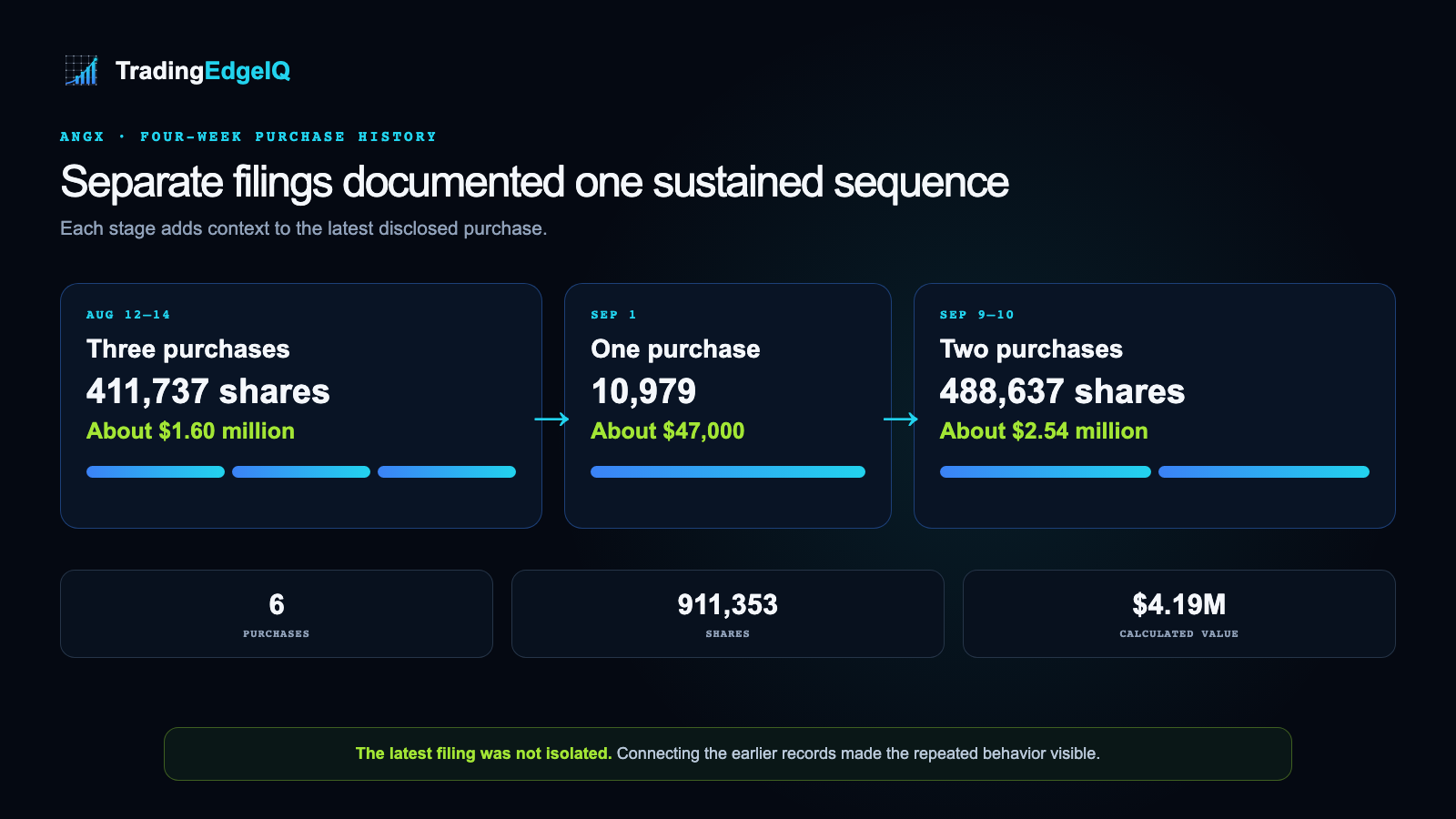
Angel Studios director Steve Sarowitz disclosed six open-market purchases between August 12 and September 10, 2026. Together, the transactions covered 911,353 shares with a calculated value of approximately $4.19 million.
The latest filing was meaningful on its own. The more useful research insight appeared when that filing was connected to the five purchases that came before it.
The situation: six purchases appeared across four filings
The transactions formed three visible stages:
- August 12 through August 14: Three purchases totaling 411,737 shares, worth approximately $1.60 million.
- September 1: Another 10,979 shares, worth approximately $47,000.
- September 9 and September 10: Two more purchases totaling 488,637 shares, worth approximately $2.54 million.
The final transaction was the largest. Sarowitz reported buying 355,998 shares on September 10 at a weighted-average price of approximately $5.28 per share, for a calculated value of approximately $1.88 million.
Every transaction was reported as an open-market purchase. Angel Studios identifies Sarowitz as a member of its board of directors.
The complication: the pattern was divided across dates and filings
SEC Form 4 filings are transaction records. They arrive as separate disclosures, and one filing can contain more than one transaction row. Reading only the newest row can hide the sequence that preceded it.
In this case, the latest filing contained the September 9 and September 10 purchases. The earlier August and September 1 purchases remained in separate filings. A researcher scanning only the latest form would see a large purchase, but not the complete four-week pattern.
That distinction matters because repeated activity by one person answers a different question from independent purchases by several insiders. This case shows persistence by one director. It does not show a multi-insider cluster.
The question: why did the latest activity rank at 83?
TradingEdgeIQ's Public Filings Intelligence solution assigned the latest connected activity an Activity Relevance score of 83 with High Evidence Confidence.
The score ranked the activity for research attention. It did not predict the direction of Angel Studios shares. The main reasons were understandable without reading a scoring specification:
- The latest disclosed purchase was substantial. Its calculated value was approximately $1.88 million.
- The purchase was part of a repeated pattern. Six purchases by the same director appeared within the system's 60-day comparison window.
- The latest purchase was large relative to a comparable earlier holding. That made the ownership change more useful to examine.
- The filing clearly identified the company, director, transaction, and ownership details. That supported High Evidence Confidence.
The score and confidence label answer different questions. The score describes how strongly the activity deserves attention. Evidence Confidence describes how well the available records support that assessment.
The resolution: connect the latest filing to the history
The useful workflow is straightforward:
- Start with the latest disclosure. Confirm the transaction type, date, shares, price, and reported ownership.
- Review the connected history. Determine whether the event is isolated or part of repeated activity.
- Explain the score in plain language. A number is useful only when the investor can see what drove it.
- Keep the source evidence close. Open the original filings before drawing a conclusion.
This case shows what connected public-filing research can add. One form documented the latest transactions. The complete history showed a director purchasing shares repeatedly across four weeks.
It does not establish Sarowitz's motivation, predict future returns, or recommend buying or selling ANGX. It creates a clearer and more efficient starting point for further research.
Primary sources
- August 12 and August 13 Form 4
- August 14 Form 4
- September 1 Form 4
- September 9 and September 10 Form 4
- Angel Studios board of directors
The names, role, transaction dates, share counts, weighted-average prices, and ownership details come from these public records. Calculated values equal the reported shares multiplied by the reported weighted-average prices and are rounded for readability.
Explore Public Filings Intelligence to review SEC disclosures with connected history, plain-language scores, and source-level evidence.
Across other sources: AXON: What Were Federal Agencies Buying? connects lobbying and procurement records. Contract Win. Time to Buy? explains how to interpret contract activity and its research score. For another filing comparison, Two Upstart Filings. One Bullish-Leaning Picture. shows why transaction types carry different weight.
Continue the public-filings series
Previous: Two Uber Insider Purchases, One Research Signal
Next: Why Insider Clusters Deserve a Closer Look
The next case changes the structure of the evidence. Instead of repeated purchases by one director, it examines independent purchases by several insiders and asks when corroboration should change research priority.
TradingEdgeIQ is a research and decision-support platform. This case study is based on public disclosures and recorded product evidence. It is intended for research and education and does not provide personalized investment advice or recommend buying or selling any security.
Research and analytics only. No auto-trading. No financial advice. Historical and simulated results do not guarantee future performance.
Related