The Enovis Insider Cluster: What Four Purchases Revealed During a 24.5% Drop
Two Enovis executives made four open-market purchases as the stock declined following the eCential Robotics announcement, showing how related filings add context without predicting price.
Anuj Saxena · Founder, TradingEdgeIQ
Previously in this public-filings series: Beyond the Buy: Inside Amrize’s Disclosures
Next in the reading path: Why Insider Clusters Deserve a Closer Look
One filing is a data point. Four purchases by two senior executives, made while the market was repricing a company announcement, create a more useful research context.
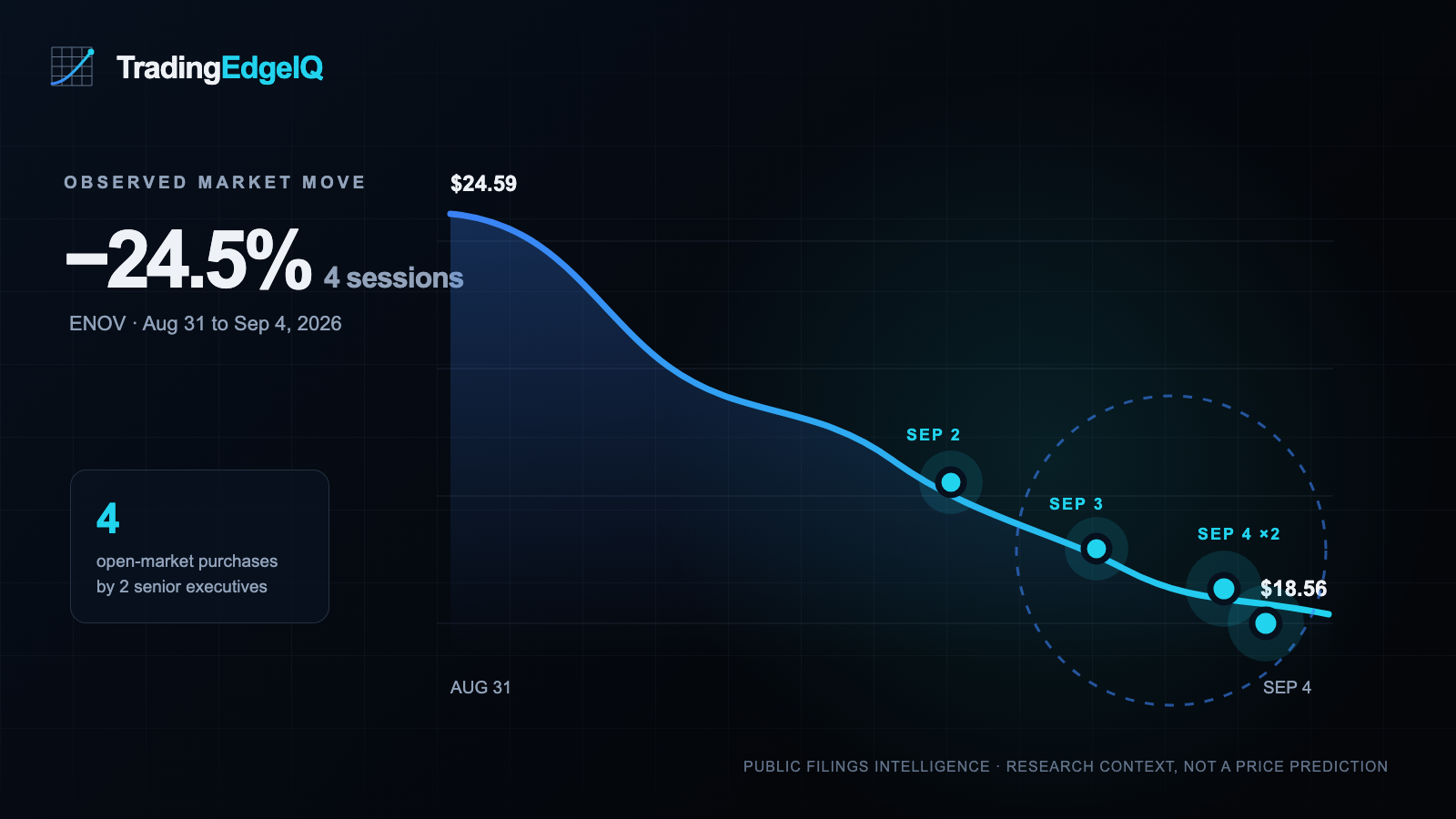
Enovis announced a planned acquisition. The stock fell sharply. During the decline, its chief administrative officer bought on three consecutive trading days and its chief executive officer bought alongside him on the third.
That sequence is worth examining because the filings reinforce one another. It is not a prediction of what the stock will do next.
The situation: a sharp repricing after an acquisition announcement
On September 1, 2026, Enovis announced a binding offer to acquire eCential Robotics. The proposed transaction included an upfront enterprise value of €155 million, approximately €176 million of cash consideration at closing, and up to €35 million of contingent consideration.
The company also said it expected the deal to create a 100-basis-point adjusted EBITDA margin headwind in 2027, after combining 150 basis points of transaction-related dilution with 50 basis points of underlying improvement. Enovis expected a return to year-over-year margin improvement in 2028. Read the Enovis announcement.
The market response was immediate. Enovis closed at $24.59 on August 31, before the announcement, and $20.53 on September 1. By September 4, the stock closed at $18.56, a decline of approximately 24.5% over four trading sessions. The September 4 intraday low was $18.52. Review the company’s historical stock table.
Those prices describe a repricing. They do not tell us whether the market reaction was excessive, whether the proposed acquisition will create value, or where the stock will trade next.
The complication: four purchases arrived across three filings
Against that backdrop, Enovis executives disclosed four open-market purchases:
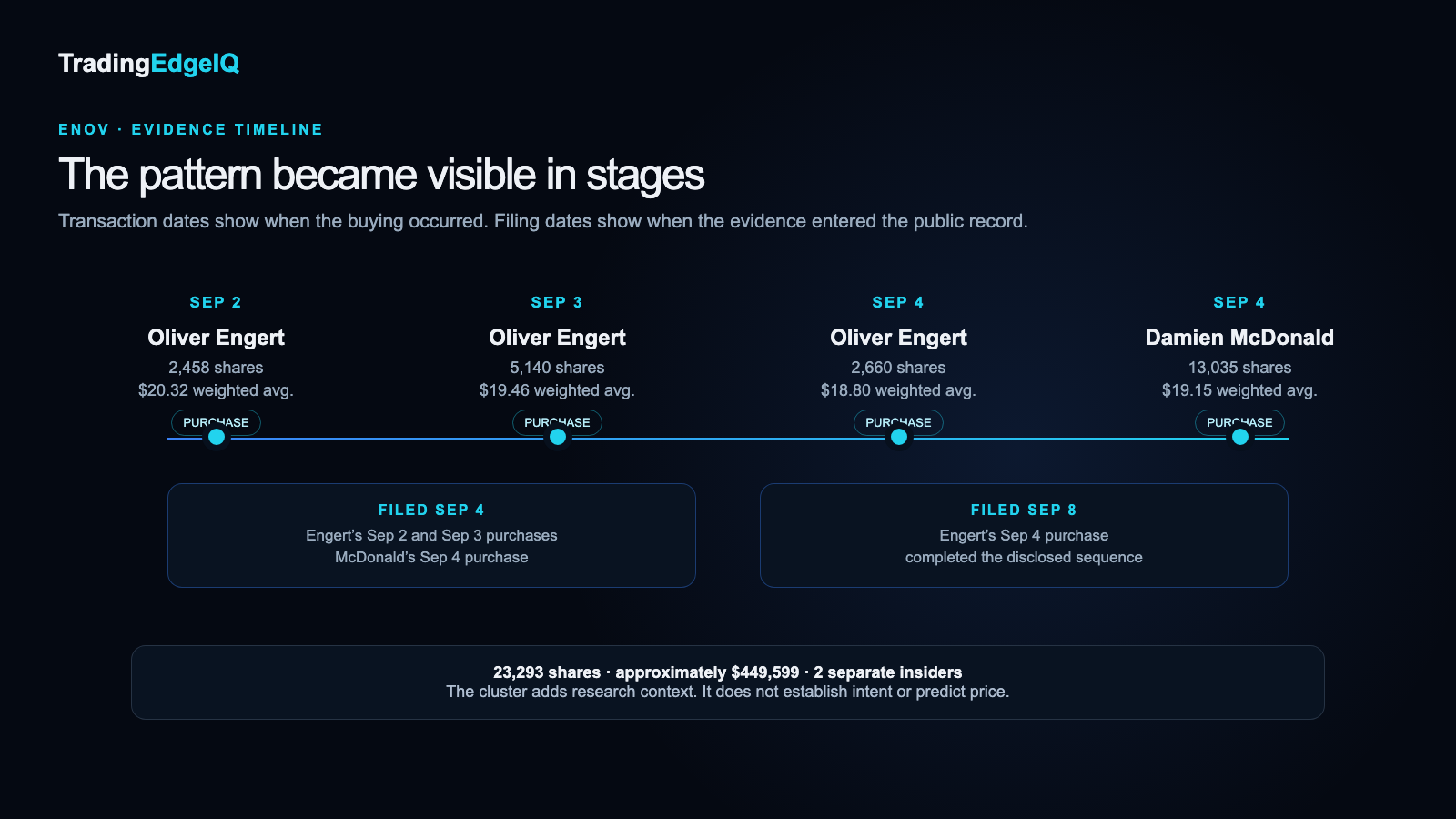
- September 2: Chief Administrative Officer Oliver Engert bought 2,458 shares at a weighted-average price of $20.32, a calculated value of $49,946.56.
- September 3: Engert bought 5,140 shares at a weighted-average price of $19.46, a calculated value of $100,024.40.
- September 4: Engert bought 2,660 shares at a weighted-average price of $18.80, a calculated value of $50,008.00.
- September 4: Chief Executive Officer Damien McDonald bought 13,035 shares at a weighted-average price of $19.15, a calculated value of $249,620.25.
Together, the disclosures covered 23,293 shares and approximately $449,599 in calculated purchase value.
The sequence was not visible all at once. McDonald’s September 4 transaction and Engert’s September 2 and 3 transactions were filed on September 4. Engert’s September 4 purchase appeared in a separate filing on September 8.
That disclosure timing matters. A researcher looking on September 5 could see two executives buying, but not yet the final Engert transaction. The full four-purchase sequence became public only after the last filing arrived.
The question: what changes when the filings are read together?
Each purchase has standalone facts: reporting person, role, transaction date, shares, price, ownership, and filing time. Read separately, each is one disclosure.
Read together, the evidence gains three kinds of context:
- Independence: two different senior executives reported purchases.
- Repetition: Engert bought across three consecutive trading days rather than in one transaction.
- Market context: the purchases occurred while the stock was declining after a company announcement with disclosed financing and margin implications.
The cluster does not prove that the two executives coordinated, shared the same motivation, or believed the decline had reached a bottom. The filings do not say any of those things.
The useful conclusion is narrower: a researcher can treat the activity as a connected evidence set instead of four isolated rows.
The resolution: the cluster adds context, not certainty
TradingEdgeIQ’s Public Filings Intelligence is designed to connect disclosures that deserve to be reviewed together. In this case, the relevant unit is not “four forms” or “four insiders.” It is four purchases by two separate insiders, connected by issuer, direction, timing, and transaction type.
That distinction avoids two common errors. Repeated transactions by one person should not be inflated into several independent insiders, and a genuine cluster should not be reduced to only the largest purchase.
For Enovis, the filings support a research question, not a trading conclusion: why did two senior executives commit personal capital during a sharp repricing, and how should that activity be evaluated alongside the acquisition’s strategic opportunity, funding, expected margin pressure, and execution risk?
Public Filings Intelligence helps organize that question by keeping the transaction evidence, reporting roles, timing, and source filings close to the signal. It does not convert the pattern into a forecast.
Primary sources
- Enovis announcement of its binding offer to acquire eCential Robotics
- Enovis historical stock lookup for the week of August 31, 2026
- Damien McDonald Form 4 filing index, accession 0001193125-26-384027
- Oliver Engert Form 4 filing index, accession 0001193125-26-384028
- Oliver Engert Form 4 filing index, accession 0001193125-26-385615
The share counts, weighted-average prices, reporting roles, transaction dates, and filing chronology above come from those records. Calculated values are shares multiplied by the reported prices and may differ slightly from totals calculated from individual executions within the disclosed price ranges.
Explore Public Filings Intelligence to research SEC disclosures with connected context and source-level evidence.
Previous in this public-filings series
Beyond the Buy: Inside Amrize’s Disclosures
Next in the reading path
Why Insider Clusters Deserve a Closer Look
TradingEdgeIQ is a research and decision-support platform. This case study is based on public disclosures, is intended for research and education, and does not provide personalized investment advice or recommend buying or selling any security.
Research and analytics only. No auto-trading. No financial advice. Historical and simulated results do not guarantee future performance.
Related