
Same Code, Different Evidence: What Two MAIR Purchases Reveal
Two Madison Air Solutions purchases used the same SEC transaction code on the same day. The filings show why ownership, role, counterparty, structure, and footnotes matter more than the headline amount.
Anuj Saxena · Founder, TradingEdgeIQ
Previously in Insights: The Best Parameter Is Often the Wrong Answer
Next in the reading path: Donald Trump Disclosed 1,051 Trades. Which Ones Mattered?
Continue this public-filings case-study path: Beyond the Buy: Inside Amrize’s Disclosures.
A transaction code can classify an event. It cannot explain the evidence.
On August 25, 2026, two purchases of Madison Air Solutions Corporation shares appeared in separate SEC ownership filings. Both used transaction code P. Both involved the same issuer. Both occurred on the same transaction date.
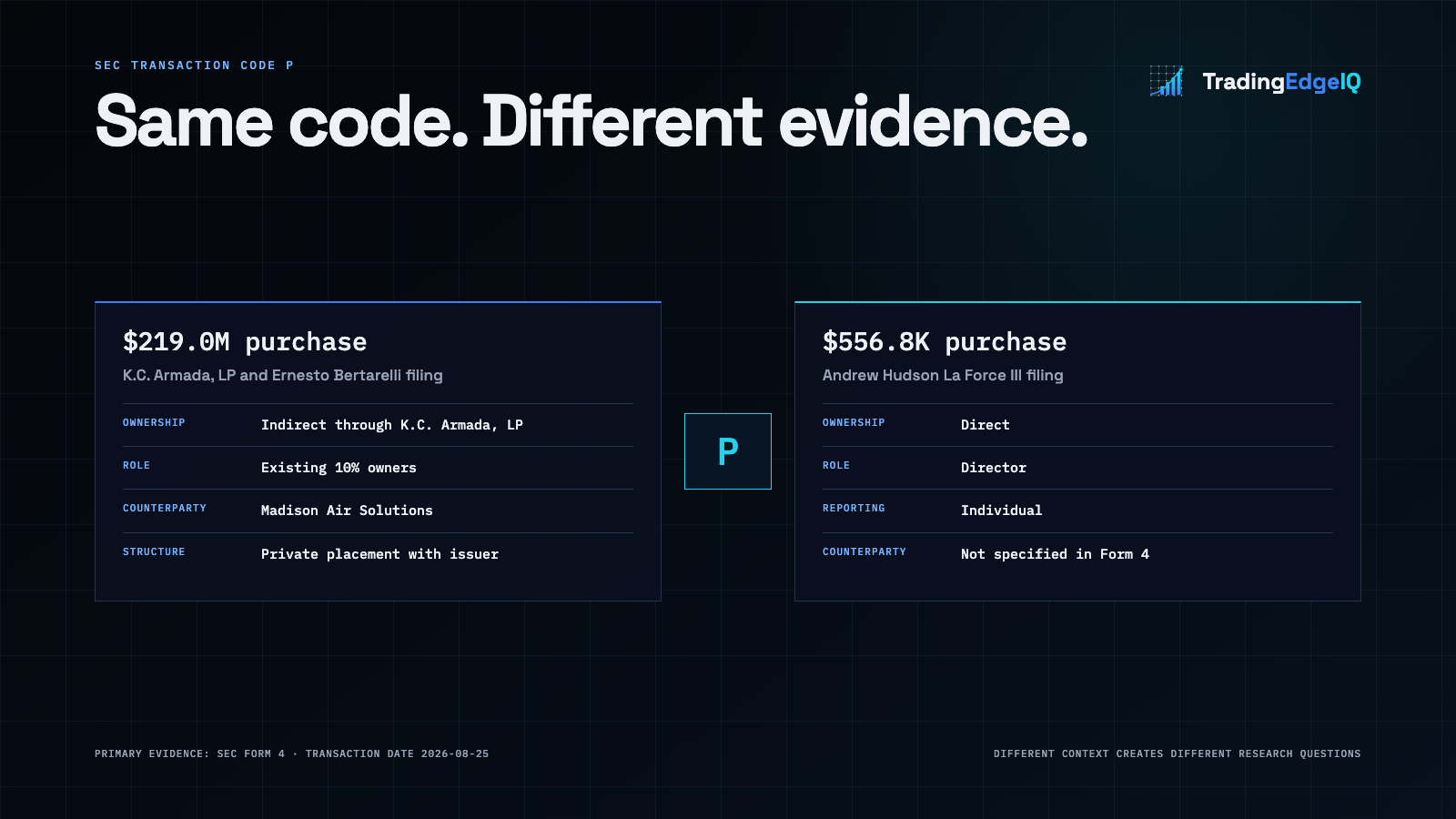
One represented 8,770,524 shares at $24.97, a calculated value of approximately $219.0 million. The other represented 20,000 shares at $27.84, or $556,800.
The difference in value is dramatic. It is also the least interesting part of the comparison.
The filings describe different reporting people, different ownership forms, and different levels of counterparty and transaction detail. Those distinctions change the research questions a careful reader should ask. They do not establish intent, predict price performance, or turn either filing into a recommendation.
This is why a public filing should be treated as a connected evidence set, not a headline number.
The situation: two purchases, one transaction code
SEC Form 4 transaction code P means an open-market or private purchase of a non-derivative or derivative security. It tells us the direction and broad transaction category. It does not tell us who economically controlled the purchase, whether the shares were bought on an exchange or from the issuer, or how the reporting person is connected to the entity that acquired them.
The first filing was submitted for K.C. Armada, LP and Ernesto Bertarelli. It reported K.C. Armada's acquisition of 8,770,524 Madison Air Solutions shares at $24.97. The filing states that the shares were purchased from the issuer in a private placement. Ownership was reported indirectly through K.C. Armada, and Bertarelli disclaimed beneficial ownership except to the extent of his pecuniary interest.
The second filing was submitted for Andrew Hudson La Force III, a Madison Air Solutions director. It reported the acquisition of 20,000 shares at $27.84, with the resulting shares held directly.
Both disclosures are fresh. Both deserve accurate classification. Neither can be understood from code P and transaction value alone.
The complication: code P hides material differences
If these two records are sorted only by estimated transaction value, the larger purchase dominates the screen. That ranking answers one narrow question: which disclosed purchase involved more capital?
It does not answer which evidence deserves the first research look.
The larger transaction was not a direct personal purchase by Ernesto Bertarelli. K.C. Armada, LP was the purchasing entity. The shares came from Madison Air Solutions through a private placement, and the reported ownership interest was indirect. Those facts raise questions about financing, ownership concentration, strategic participation, the terms of the placement, and the relationship between the partnership and the issuer.
The smaller filing reports a director and direct ownership of the acquired shares, but it does not identify the counterparty in the Form 4. That context raises a different set of questions: whether other insiders acted near the same time, how the director's ownership changed, whether the filing followed a company event, and how the purchase compares with the director's prior disclosed activity.
These are different research paths. A ranking system that compresses both into “purchase” and “estimated value” hides the very distinctions that make the filings useful.
What the filing code tells us
- A purchase was reported.
- The acquisition involved a security covered by the ownership filing.
- The transaction date was August 25, 2026.
What the filing code does not tell us
- Whether the reporting person held the shares directly or through another entity.
- Whether the security came from the open market, the issuer, or another counterparty.
- Whether the purchase reflected an individual's action or an entity's transaction.
- Why the transaction occurred.
- What the stock price will do next.
The structured fields are useful. The ownership table, reporting-person relationship, and footnotes complete the evidence.
The question: what deserves the first research look?
The wrong question is: Which purchase is the stronger buy signal?
A reported purchase is not a buy signal.
Neither filing proves conviction, predicts returns, or tells another investor what to do. The research task is to identify which questions each disclosure can support and which claims remain outside the evidence.
For the approximately $219 million private placement, the first research look could focus on:
- the issuer's use of proceeds and transaction terms;
- the ownership relationship among K.C. Armada, Bertarelli, and Madison Air Solutions;
- dilution, concentration, and governance implications;
- related SEC filings that describe the placement; and
- whether the acquisition changed an already significant position.
For the $556,800 director purchase, the first research look could focus on:
- the director's prior ownership and transaction history;
- other insider activity around the same date;
- company events preceding the purchase;
- the size of the purchase relative to the director's existing holdings; and
- whether any footnote changes the apparent direct-ownership interpretation.
The larger transaction offers more scale and more structural complexity. The smaller transaction offers a direct relationship between a director and the acquired shares. One is not automatically more predictive than the other. Each earns attention for different evidentiary reasons.
That is the practical lesson: priority should come from connected context, not size alone.
The resolution: read the filing as a connected evidence set
A repeatable public-filings workflow can preserve both speed and accuracy.
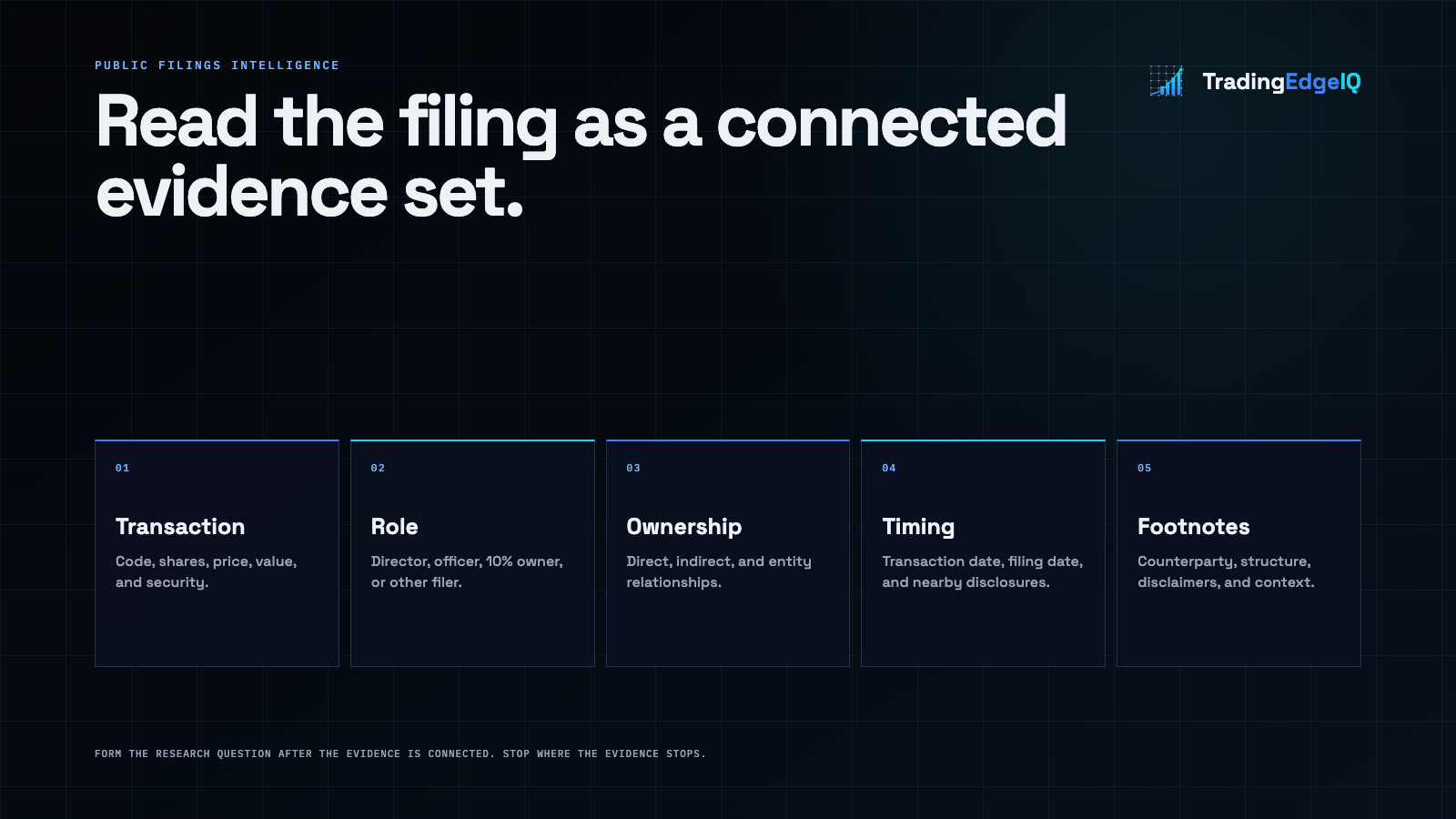
1. Start with the event
Record the issuer, transaction date, transaction code, shares, price, and calculated value. These fields establish the basic disclosed event.
2. Identify the reporting person and role
Determine whether the filer is an officer, director, 10% owner, or another reporting person. Multiple roles can apply, and the role changes the questions worth asking.
3. Trace ownership
Separate direct ownership from indirect ownership. If an entity holds the shares, identify the entity rather than casually attributing the transaction to an individual named elsewhere in the filing.
4. Check the timing
Separate the transaction date from the public filing date. Then compare the event with relevant company disclosures and nearby insider activity without implying causation.
5. Read the transaction structure and footnotes
Check the counterparty, private-placement language, disclaimers, derivative details, and explanatory notes. This is often where a generic transaction code becomes a specific event.
After those five steps, form the research question rather than a trading conclusion. Decide what additional evidence would clarify the event, then stop where the evidence stops.
This process turns a filing feed into a research system. It preserves the convenience of structured data without pretending that a row contains the whole story.
The two official filings
The analysis above is based on the following SEC records:
- K.C. Armada, LP and Ernesto Bertarelli Form 4 filing, accession number 0001193125-26-371312.
- Andrew Hudson La Force III Form 4 filing, accession number 0001628280-26-059013.
The records support the reported dates, roles, share counts, prices, ownership forms, and transaction descriptions discussed here. They do not provide evidence of motivation or future market performance.
What this case study reveals
The most visible number in a filing is not always the most informative fact.
In this case, transaction code P placed two very different events in the same broad category. The approximately $219 million transaction involved an existing 10% owner, an acquiring partnership, indirect ownership, and a private placement with the issuer. The $556,800 transaction involved a director and direct ownership.
The useful comparison is not “large versus small.” It is entity filing versus individual filing, indirect versus direct ownership, and a stated private placement versus a filing that does not identify its counterparty on Form 4.
Those distinctions do not produce a buy or sell answer. They produce better questions.
That is what public-filings intelligence should do: help a researcher move from a busy disclosure feed to the evidence that deserves inspection, while making the boundaries of the evidence visible.
📖 Previous in Insights
The Best Parameter Is Often the Wrong Answer: Why Robust Ranges Matter More Than a Single Optimum
📖 Next in the reading path
Donald Trump Disclosed 1,051 Trades. Which Ones Mattered?
From Trading Idea to Trading Decision: A More Structured Research Workflow
TradingEdgeIQ is a research and decision-support platform. This case study is based on public SEC disclosures, is intended for research and education, and does not provide personalized investment advice or recommend buying or selling any security.
Continue this public-filings case-study path with Beyond the Buy: Inside Amrize’s Disclosures, examining how ownership, size, and disclosure timing shape the evidence.
Research and analytics only. No auto-trading. No financial advice. Historical and simulated results do not guarantee future performance.
Related