
Beyond the Buy: Inside Amrize’s Disclosures
A closer look at the ownership, timing, and size behind Amrize’s insider purchase filings, including approximately $1.27 million across direct and spouse-held ownership.
Anuj Saxena · Founder, TradingEdgeIQ
A company chairman and CEO reports roughly $1.27 million in share purchases. A director at the same company also reports buying shares within days of those transactions. Together, the disclosures make an appealing headline: multiple Amrize insiders are buying.
But how much does that headline actually tell us?
Reading the underlying filings reveals a more nuanced story. The purchases differ substantially in size, the larger filing includes two ownership categories, and the transactions took place before their details appeared in the public record. Each detail changes how a reader should interpret the activity.
This builds on our earlier case study, Same Code, Different Evidence: What Two MAIR Purchases Reveal. Next, The Enovis Insider Cluster examines four purchases made by two senior executives during a sharp market repricing.
Cover art is an AI-generated conceptual cement facility, not an Amrize facility photograph.
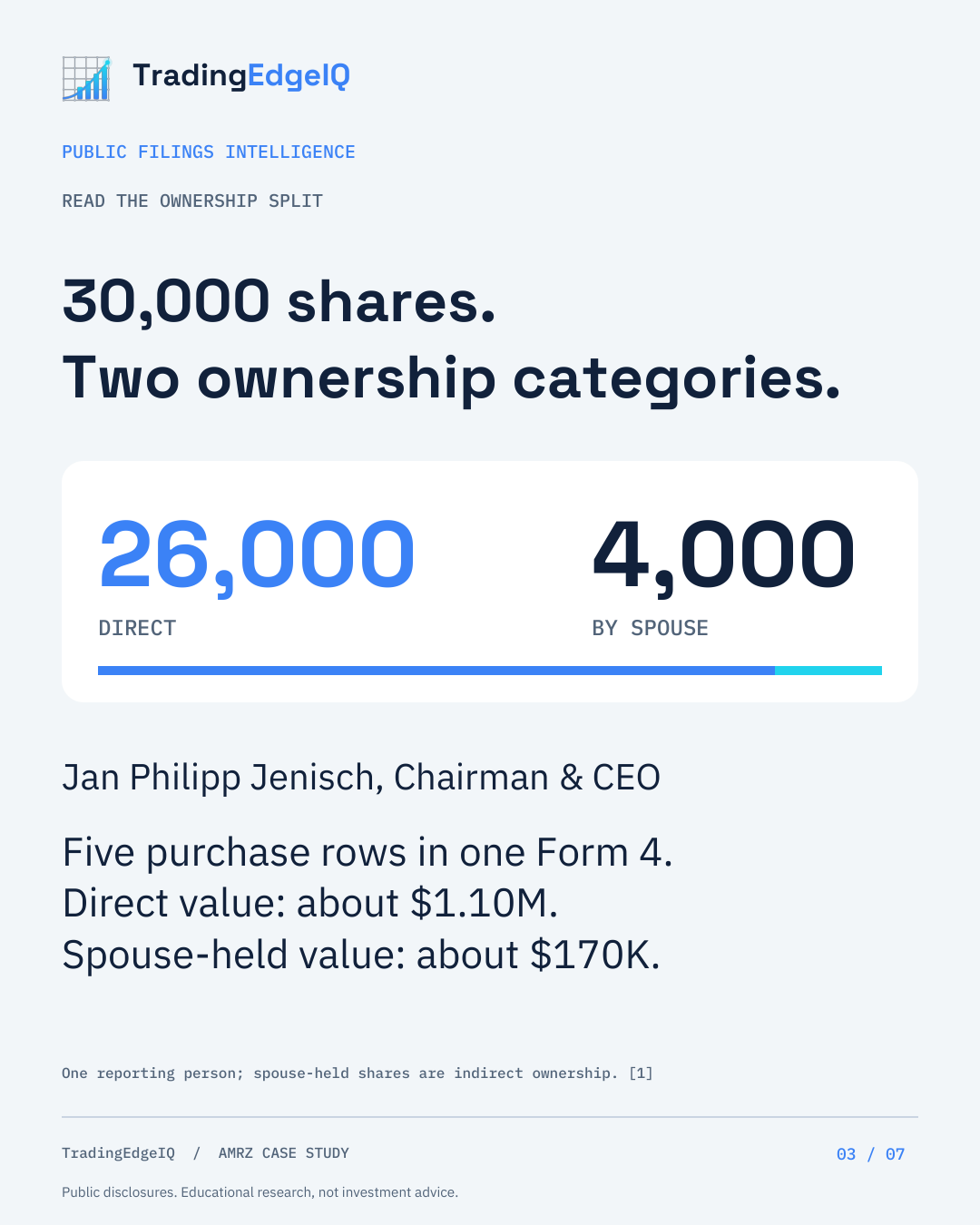
The larger purchase appears in a September 3 Form 4 filed by Amrize Chairman and CEO Jan Philipp Jenisch. It lists five purchase transactions dated September 2, totaling 30,000 ordinary shares. Using the US-dollar prices reported for each transaction, their combined value comes to approximately $1.27 million. Read Jenisch’s SEC filing.
Within that total, 26,000 shares were reported as directly owned, representing $1,104,090 in calculated purchase value. The remaining 4,000 shares, valued at $169,990, were reported as indirectly owned by spouse. Together, they account for the $1,274,080 total.
That ownership distinction belongs alongside the headline number. All five transactions appear in one reporting person’s filing; they should not be mistaken for five different insiders buying. The filing’s footnotes add another detail: some reported prices were converted from Swiss francs. The total therefore reflects a calculation using the disclosed shares and prices, rather than the holdings’ current market value.
The second filing adds a different dimension. Director Dwight Audley Konrad Gibson reported purchasing 5.47 shares at $44.58 on August 27, a transaction worth approximately $244. His reported direct holdings following the purchase were 5,199.47 shares. Read Gibson’s SEC filing.
Placed beside Jenisch’s filing, Gibson’s purchase shows why counting buyers is only a starting point. Both disclosures report purchases, yet the amounts involved are substantially different. A description such as “two insiders bought shares” captures the direction of the activity while leaving its scale unexplained. The filings also do not establish that the transactions were coordinated or that the two people shared a particular outlook for Amrize.
The dates bring the picture into sharper focus. Gibson purchased his shares on August 27 and filed the disclosure on August 31. Jenisch’s purchases followed on September 2, with his filing appearing on September 3. The SEC’s Gibson filing index and Jenisch filing index establish those filing dates.
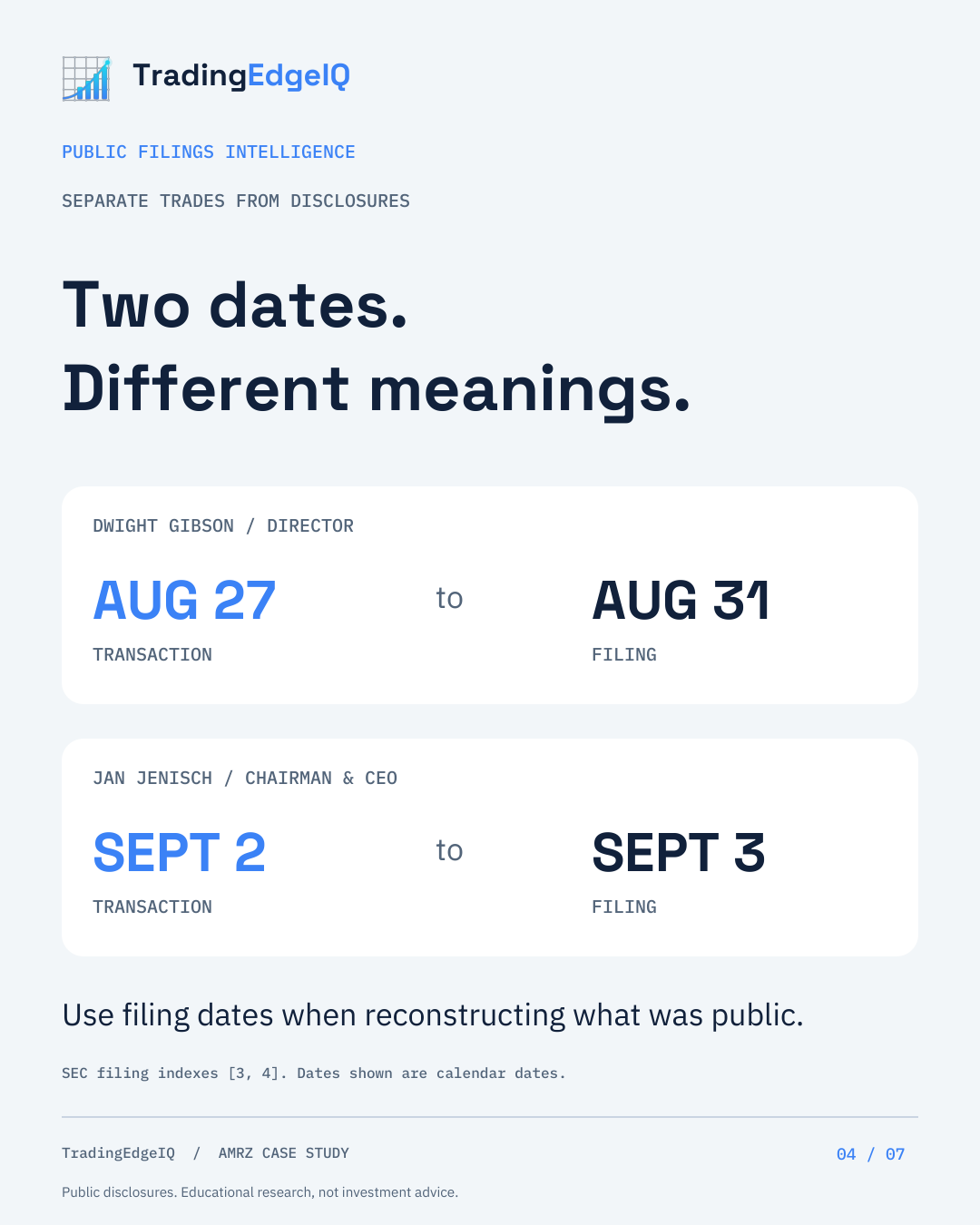
For anyone reviewing the activity alongside a stock chart, that sequence matters. The transaction date tells us when the purchase occurred. The filing date helps establish when the corresponding disclosure entered the public record. Keeping both dates visible avoids giving a historical reader the impression that they could already have read a filing on the day of the purchase.
Taken together, these details give us a clearer account of Amrize’s disclosed activity: a substantial purchase total spanning direct and spouse-held ownership, a separate director purchase of much smaller size, and a timeline that distinguishes the transactions from their disclosure.
They also provide a useful way to approach the next filing that attracts attention. Who reported the purchase, and how is the ownership described? How large was each transaction? When did it happen, and when did the filing become available? Following those questions turns a headline into something a reader can examine and evaluate.
That is the research process TradingEdgeIQ’s Public Filings Intelligence is designed to support. Ranked disclosures help readers decide where to focus, while explanations and links to SEC sources help them explore the details behind the activity. Access and available history depend on the subscription plan.
As in our MAIR case study, the underlying disclosures give meaning to the headline. Continue with The Enovis Insider Cluster, where four purchases by two senior executives show how a pattern develops as disclosures arrive.
Educational research based on public disclosures. Not investment advice or a recommendation to buy, sell, or hold AMRZ. The filings do not establish personal motives or predict future stock performance. Calculated values use reported shares and prices, with rounding as indicated.
Continue with Bill Gates’ $119 Million Waste Bet, which examines an incremental addition to an established holding alongside earnings and competitors.
Research and analytics only. No auto-trading. No financial advice. Historical and simulated results do not guarantee future performance.
Related