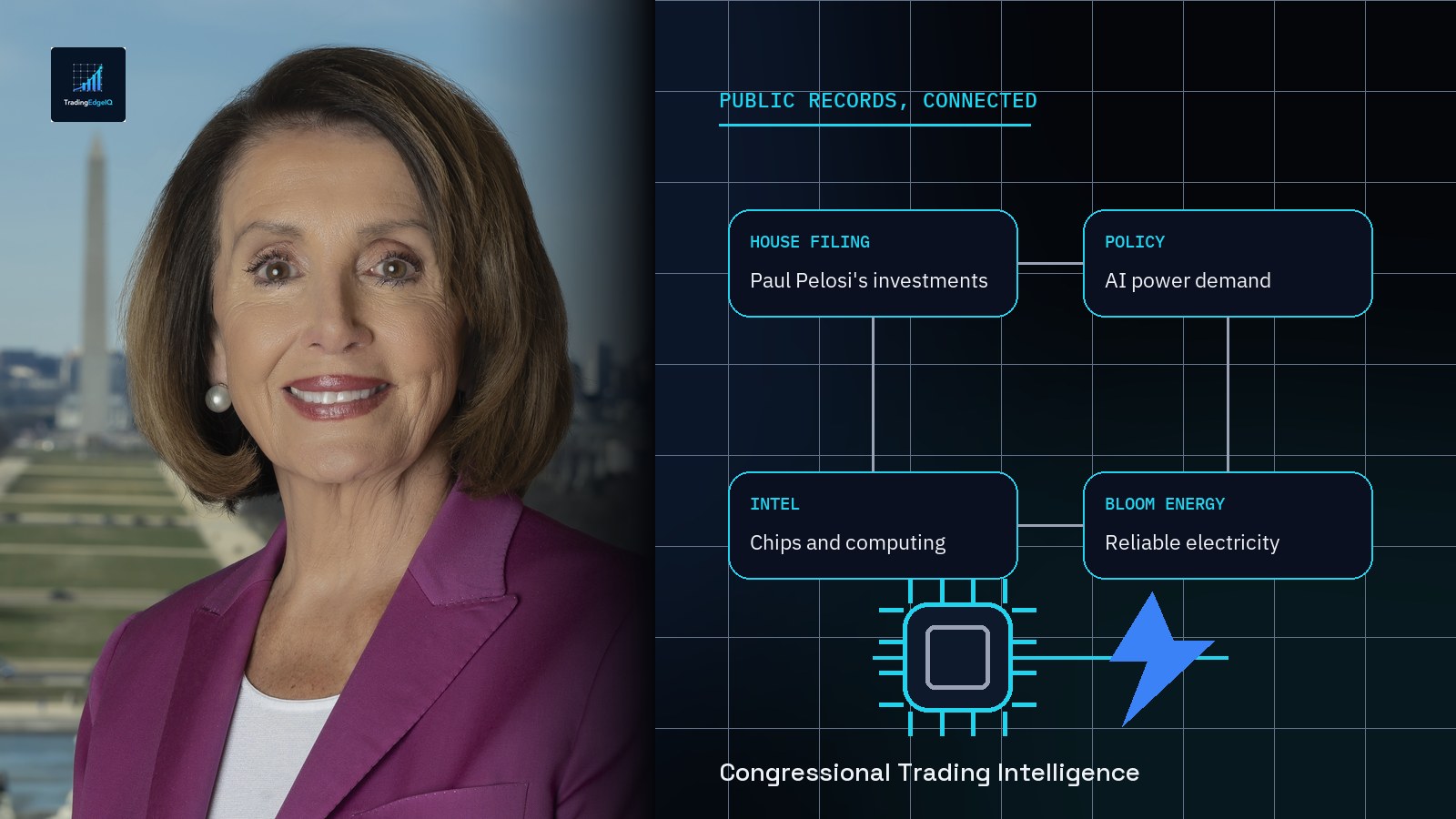
The AI Bet Nancy Pelosi Disclosed
What Paul Pelosi bought, what the public records reveal, and what they do not prove.
Anuj Saxena · Founder, TradingEdgeIQ
Previously in Insights: Donald Trump Disclosed 1,051 Trades. Which Ones Mattered?
Next in the reading path: Why a $1.44 Million Insider Purchase Needed More Context
A political trade should start the research, not end it.
An online video about a large trade connected to Nancy Pelosi raised an interesting question. Was this simply another story about a politician's portfolio, or did the public record point to something larger?
The first step is to separate the people correctly. Nancy Pelosi filed the report. Paul Pelosi made the disclosed investments. The House filing marks the assets as spouse-owned.
The second step is to separate the dates. Paul Pelosi made the investments in July. Nancy Pelosi signed and filed the report on August 21. That means outside investors did not learn about these transactions when they happened.
But the filing can still be useful. When we connect it with other public records, a broader research theme appears: artificial intelligence needs both computing chips and reliable electricity.
This case study explains how we found that theme, what the records support, and what they do not prove.
The situation: a large investment attracted attention
Nancy Pelosi's periodic transaction report disclosed several investments made by Paul Pelosi.
The report showed that he bought:
- 15,000 Bloom Energy shares, split across purchases on July 24 and July 28.
- 200 Bloom Energy call options, with a $100 strike price and a June 17, 2027 expiration date.
- 10,000 Intel shares on July 24.
- 50 Intel call options, with a $50 strike price and the same June 17, 2027 expiration date.
The exact option prices were not disclosed. The filing also does not tell us why Paul Pelosi chose these investments.
The popular version of the story focused on the size of the positions and the name Nancy Pelosi. Ross Givens's video made the case that the more interesting idea was the connection between Bloom Energy, Intel, and the buildout of AI infrastructure.
That was a useful starting point. We wanted to see whether independent public records supported the same theme.
The complication: the filing became public weeks later
The trades occurred on July 24 and July 28. Nancy Pelosi digitally signed the report on August 21, and the filing then became public.
An outside investor therefore could not have copied Paul Pelosi's July trades in real time. By the time the market could see the disclosure, several important events had already happened.
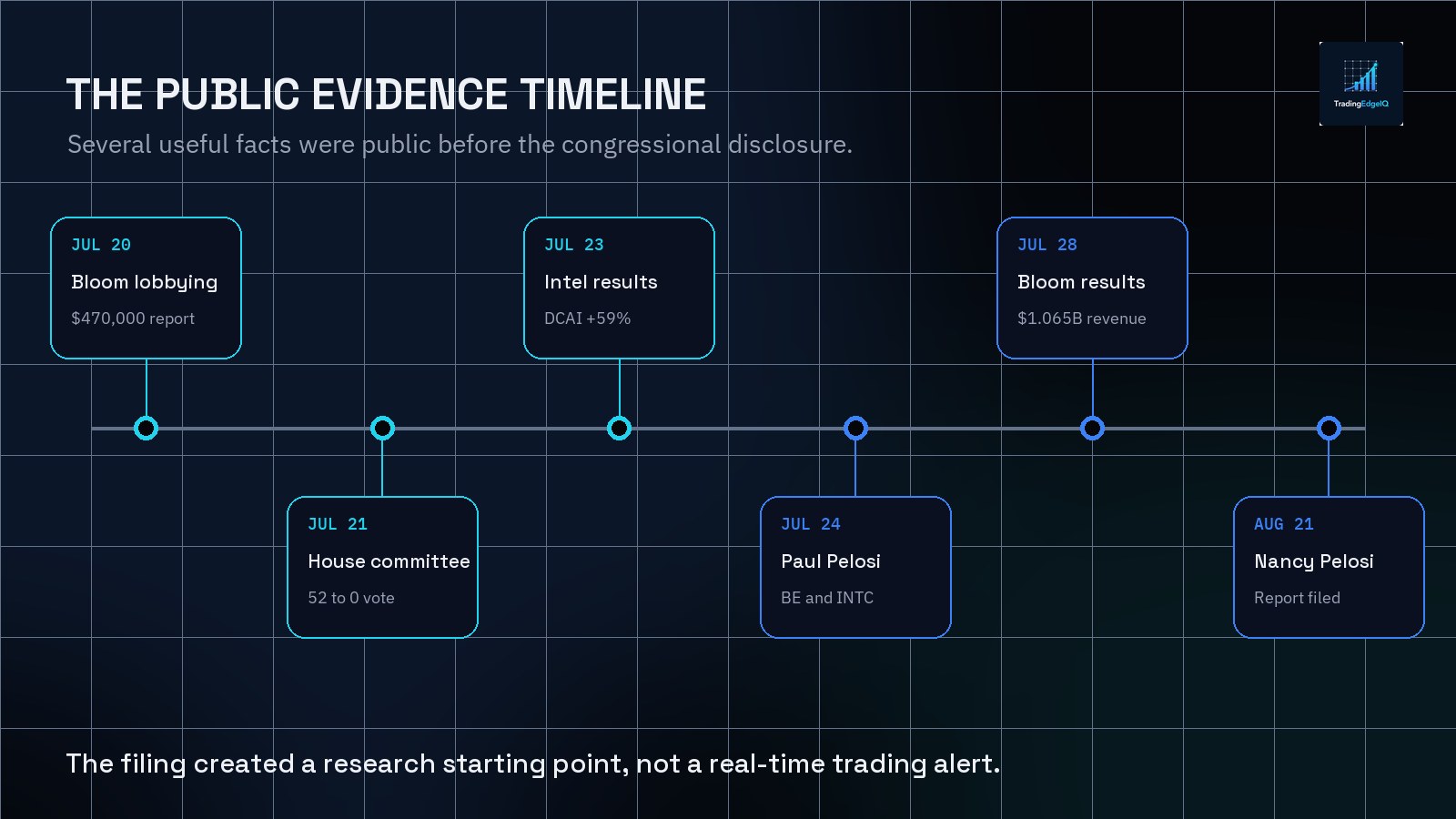
That delay changes the question. Instead of asking, "Could someone have copied the trade?" we should ask, "What does the trade help us investigate now?"
The question: what did the other public records show?
We reviewed four additional sources: a federal lobbying report, House committee activity, Intel's quarterly results, and Bloom Energy's quarterly results.
Bloom Energy was discussing power for AI data centers
Bloom Energy's federal lobbying disclosure reported $470,000 in lobbying expenses for the second quarter of 2026. It included work related to H.R. 9340 and energy delivery for artificial intelligence and data centers.
The report was digitally signed on July 20, before Paul Pelosi's Bloom Energy purchases.
A House committee advanced an energy bill
On July 21, the House Energy and Commerce Committee advanced H.R. 9340, the Ratepayer Protection Act, by a vote of 52 to 0.
Nancy Pelosi was not a member of that committee. The committee action is useful policy context, but it does not establish a connection to Nancy Pelosi or Paul Pelosi.
Intel reported stronger data-center results
Intel reported second-quarter results after the market closed on July 23. Revenue was $16.1 billion, up 25% from the prior year, and Data Center and AI revenue increased 59%.
Paul Pelosi bought Intel shares and call options on July 24, after those results were public.
Bloom Energy reported record revenue
Bloom Energy reported second-quarter results after the market closed on July 28. Quarterly revenue reached $1.065 billion, the company's first quarter above $1 billion, and it raised its full-year guidance.
Paul Pelosi made his second Bloom Energy share and option purchase on July 28. The filing gives us the date, but not the time of day. We therefore cannot say whether that purchase occurred before or after Bloom Energy released its results.
The resolution: the records reveal a theme, not a verdict
When these records are placed together, the investments look less like two unrelated company bets.
Intel represents the computing side of AI infrastructure. Bloom Energy represents the electricity side. Data centers need advanced processors, but those processors cannot operate without large amounts of dependable power.
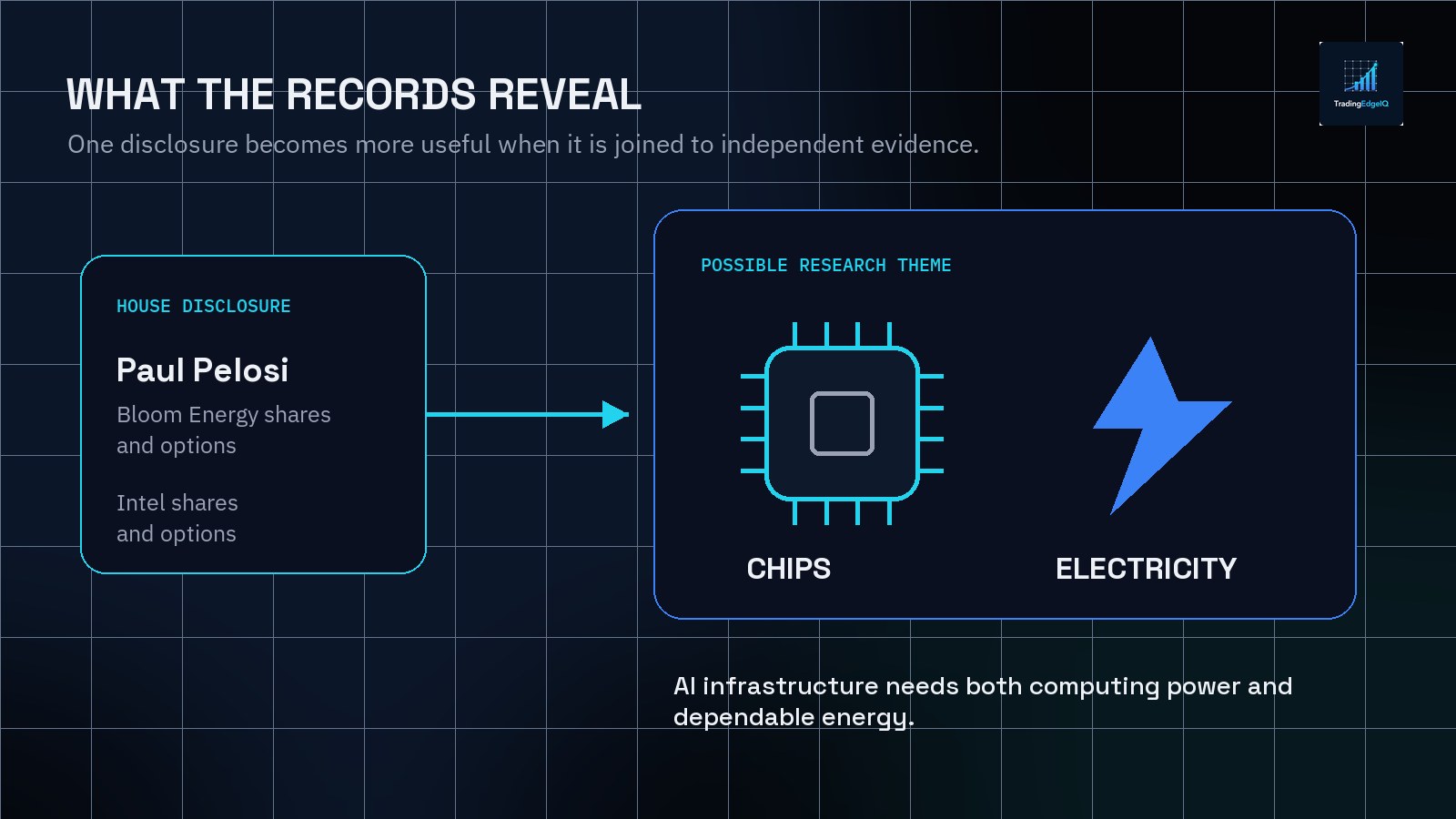
This is where alternative data research becomes useful. One filing gives us the names of two companies. Other public records help explain why those companies might belong in the same research theme.
The result is not a trading signal. It is a better question: which companies may benefit as the AI buildout creates demand for both computing capacity and reliable energy?
What the evidence supports
The public records support several clear statements:
- Nancy Pelosi filed the report.
- Paul Pelosi made the disclosed investments.
- The assets were marked as spouse-owned.
- Bloom Energy publicly lobbied on issues involving AI, data centers, and energy delivery.
- Intel's Data Center and AI business was growing quickly.
- Bloom Energy reported record quarterly revenue and raised guidance.
- The congressional disclosure became public on August 21, weeks after the trades.
What the evidence does not prove
This evidence does not prove private information, improper conduct, or why Paul Pelosi selected these investments.
They do not show that Nancy Pelosi's official work caused the trades. They do not establish the exact prices paid for the options. They also do not tell us what either stock will do next.
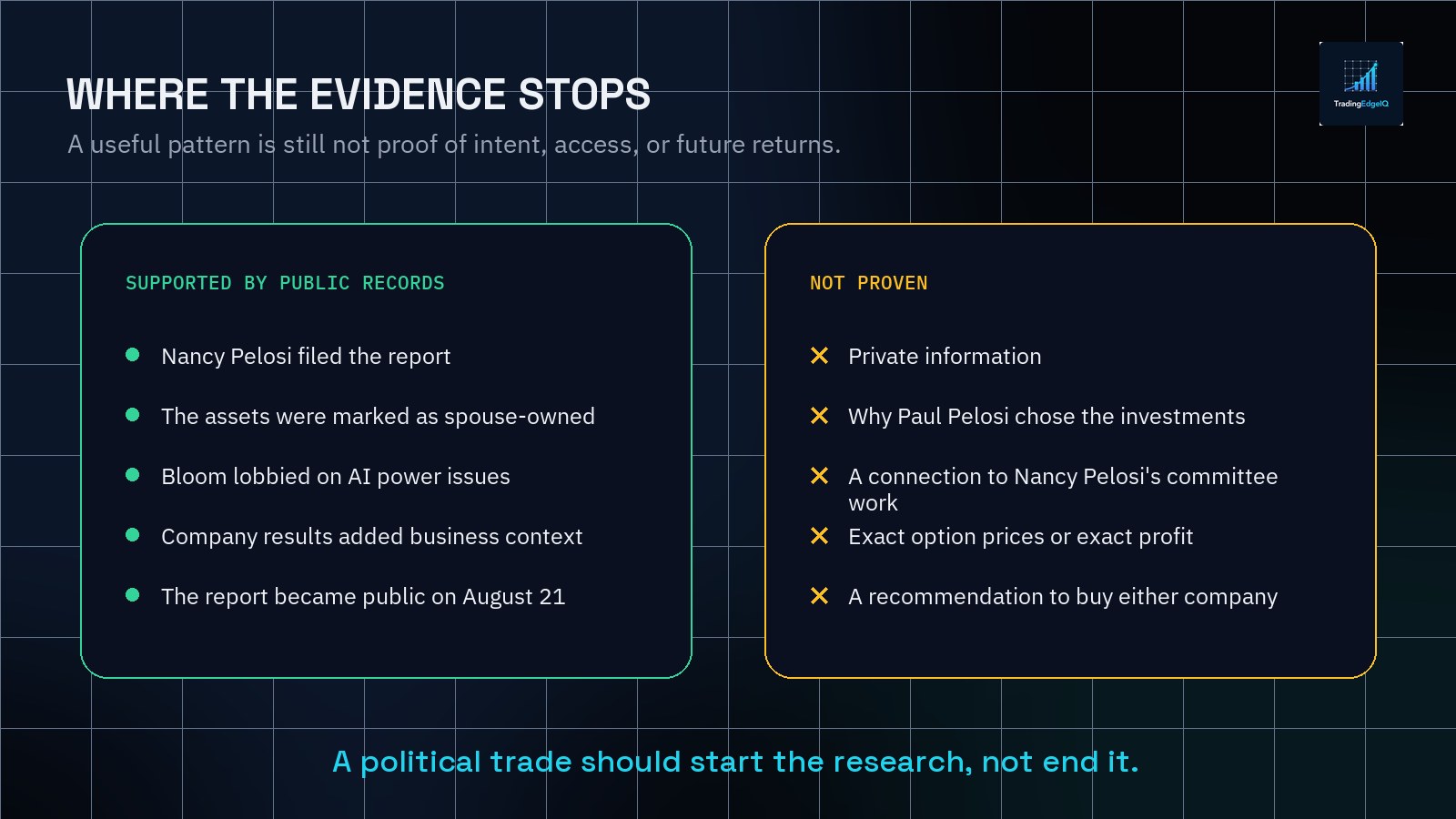
That boundary matters. A compelling pattern can guide deeper research without becoming an accusation.
A practical research method
This case suggests a simple process for reviewing future congressional disclosures:
- Identify who made the investment. The public official and the asset owner may not be the same person.
- Separate the transaction date from the filing date. This shows what outside investors could actually know at the time.
- Read the complete filing. Shares, options, ownership codes, and value ranges can change the meaning of a headline.
- Connect independent public records. Company results, lobbying reports, government actions, and other disclosures can add context.
- State what the evidence cannot prove. A research theme is not proof of intent, access, or future returns.
The lasting lesson is straightforward: a political trade should start the research, not end it.
TradingEdgeIQ's Congressional Trading Intelligence solution is designed to organize that work. It helps researchers connect disclosed transactions with timing, ownership, and related public evidence, while keeping the limits visible.
Sources
- U.S. House Clerk periodic transaction report, filing 20035143
- Bloom Energy federal lobbying disclosure
- House Energy and Commerce Committee announcement on H.R. 9340
- Intel second-quarter 2026 financial results
- Bloom Energy second-quarter 2026 financial results
- Ross Givens: Pelosi's Final Big Bet
📖 Previous in Insights
Donald Trump Disclosed 1,051 Trades. Which Ones Mattered?
📖 Next in the reading path
Why a $1.44 Million Insider Purchase Needed More Context
TradingEdgeIQ is a research and decision-support platform. This case study uses public disclosures and independent public sources for research and education. It does not provide personalized investment advice or recommend buying or selling any security.
Research and analytics only. No auto-trading. No financial advice. Historical and simulated results do not guarantee future performance.
Related