
Salazar and Meta: two purchases, then a partial sale
Read the Meta purchases, account labels and partial sale together. Congressional disclosure ranges tell a fuller story than a sale headline.
Anuj Saxena · Founder, TradingEdgeIQ
A congressional stock-sale headline can sound like someone left an investment. Maria Elvira Salazar’s Meta disclosure shows why the full sequence matters.
The report signed on October 7, 2026 lists two purchases of Meta shares on September 22, followed by a partial sale on September 24. The purchases appear in two different account labels; the partial sale appears in the IRA.
What does the disclosure actually establish? This case explains why dates, account labels and dollar ranges give a fuller picture than the sale headline alone.
Previous in this research collection: Marvell: follow the issue behind a $50,000 lobbying report.
Continue with: 51Talk: the units behind a $32 million buying headline.
Read the rows in date order
The original House Periodic Transaction Report lists one September 22 Meta purchase in a UBS Brokerage account and another in a UBS IRA. An IRA is a retirement account.
Two days later, it reports a partial sale in the UBS IRA. The October 7 date is the report’s signed date, not the date those trades occurred.
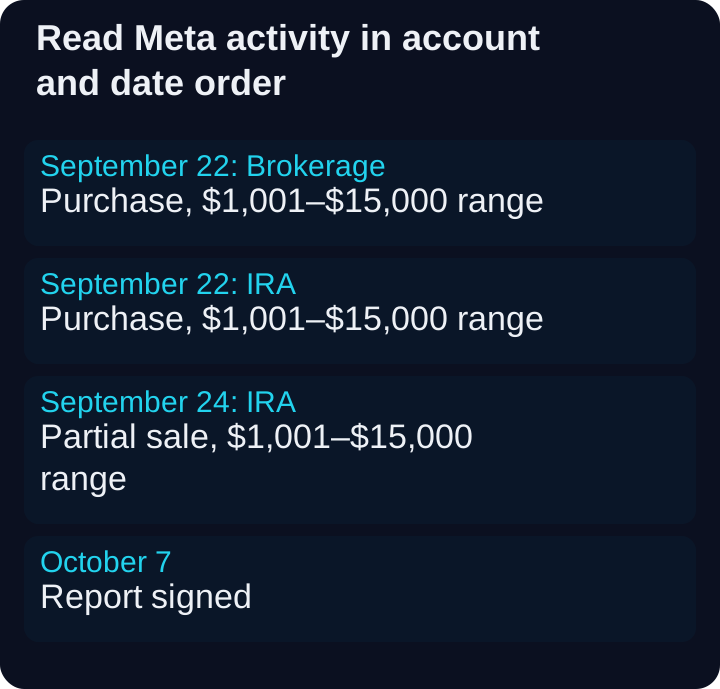
The account labels keep the activity from being flattened into one undifferentiated list. The sequence includes purchases before the reported partial sale.
Partial is a meaningful detail
A partial sale describes selling some shares. It differs from a transaction labeled as a complete exit. That wording changes what a researcher can conclude from the sale row.
The report does not provide a precise remaining-share balance for this example. The appropriate conclusion comes from the disclosure’s transaction label and sequence, rather than an invented calculation of the holding left afterward.
Dollar ranges are not exact amounts
Each of these transactions is reported in the $1,001–$15,000 range. That band is the disclosure, not an exact purchase or sale value.
Subtracting the same range labels does not produce a precise net investment. A purchase near one end of the band and a sale near the other could give a different result from another pair of amounts within those bands.
The useful facts remain concrete: two reported purchases, their account labels, a later partial sale and the disclosed amount bands.
How the TradingEdgeIQ research approach helps
TradingEdgeIQ’s evidence-led approach to congressional-trading research starts with the original disclosure. Comparing the rows, account labels and sale details gives an investor a more complete basis for judgment.
This case teaches that research method using the House report. It keeps the attention on what the document establishes and the questions worth investigating, without inferring personal motive or special information.
Read the sequence before the headline
The case establishes two purchases followed by a partial sale, reported in ranges and across labeled accounts. The lesson is to preserve those distinctions when deciding what deserves further research.
The next case examines another detail that can dramatically change a transaction headline: do the share quantity and quoted price use the same units?
TradingEdgeIQ helps you find meaningful signals sooner, research them more thoroughly, and make better-informed investment decisions. Explore Congressional Trading Intelligence.
Previous in this research collection: Marvell: follow the issue behind a $50,000 lobbying report.
Continue with: 51Talk: the units behind a $32 million buying headline.
Image credit: Generated editorial concept image. It does not depict a verified company property, product or transaction.
Research and analytics only. No auto-trading. No financial advice. Historical and simulated results do not guarantee future performance.
Related