
51Talk: the units behind a $32 million buying headline
One 51Talk ADS represents 60 ordinary shares. Matching the units changes selected purchases from roughly $32 million to about $538,000.
Anuj Saxena · Founder, TradingEdgeIQ
A roughly $32 million buying headline becomes about $538,000 when the quantity and price use matching units.
The purchases still happened. The apparent size changed because 51Talk’s filing reports ordinary-share quantities while a price footnote quotes dollars per ADS. For this company, one ADS represents 60 ordinary shares.
How can that create such a large difference? This case explains the units and the calculation so an investor can judge the reported commitment more accurately.
Previous in this research collection: Salazar and Meta: two purchases, then a partial sale.
Continue with: Boeing: a $14.7 billion contract is not today’s revenue.
What ADS means
ADS stands for American Depositary Share. It represents an interest in shares of a foreign company. The number of ordinary shares represented by one ADS varies by company.
For 51Talk, the Form 4 submitted on October 8, 2026 states that one ADS represents 60 Class A ordinary shares. The reported purchases occurred in September, not on the October filing date.
Match the quantity with the price
Imagine a carton contains 60 eggs. Your receipt counts individual eggs, but the quoted price is for a whole carton. Multiplying the egg count directly by the carton price would exaggerate what you spent by a factor of 60.
The same unit problem appears when ordinary-share quantities are multiplied by a per-ADS price. First convert the ordinary-share quantity into ADS-equivalent units, then apply the ADS price.
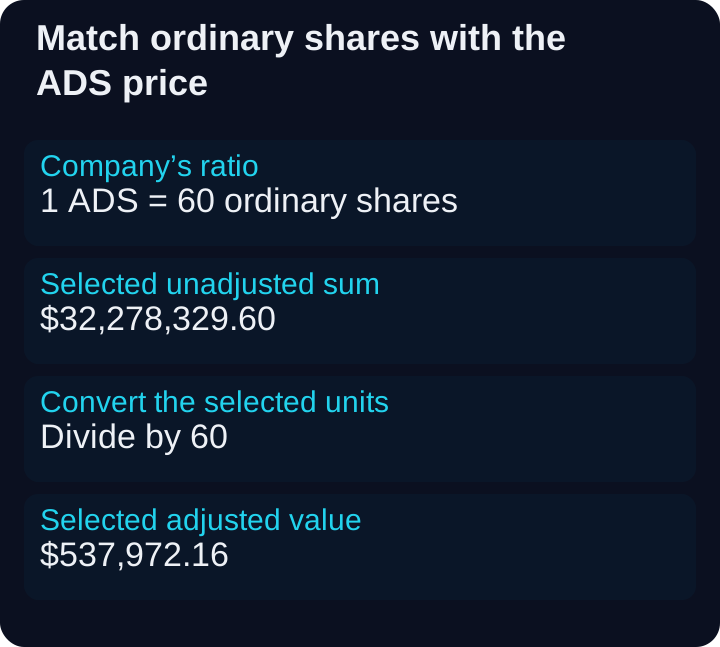
For the selected four-date purchases used in the case study, the unadjusted quantity-times-price sum is approximately $32,278,329.60. Dividing by 60 gives $537,972.16, or approximately $538,000.
Keep the selection clear
The filing has six purchase dates: September 17, 18, 22, 23, 24 and 25. The selected four-date calculation is the comparison used in the approved video. It is not the total of every purchase row.
Adjusting all six purchase rows gives approximately $538,892.16. Keeping the selected comparison separate from the full filing prevents a new aggregation error while correcting the unit mismatch. Calculations based on reported prices are approximate.
How careful filing research helps
This is the filing research TradingEdgeIQ encourages: check the share type, read the footnotes and verify the value before allowing a dramatic headline to shape an investment judgment.
The payoff is practical. Matching units helps distinguish a genuinely large commitment from a number made large by a calculation mismatch. The source filing supplies the terms for doing that work.
Check the units before interpreting the amount
This case establishes a 60-to-one ADS ratio and different units for quantities and prices. Matching them changes the selected purchases to approximately $538,000. The lesson is to verify what each number measures before multiplying it.
The next case moves from transaction values to contract values. What must an investor investigate before treating a multibillion-dollar contract headline as current revenue?
TradingEdgeIQ helps you find meaningful signals sooner, research them more thoroughly, and make better-informed investment decisions. Explore Public Filings Intelligence.
Previous in this research collection: Salazar and Meta: two purchases, then a partial sale.
Continue with: Boeing: a $14.7 billion contract is not today’s revenue.
Image credit: Generated editorial concept image. It does not depict a verified company property, product or transaction.
Research and analytics only. No auto-trading. No financial advice. Historical and simulated results do not guarantee future performance.
Related