
Talos Energy: repeated selling reduced a major holding
Across six October sessions, a major shareholder sold about 9.7 million shares. The remaining stake matters as much as the estimated $167 million headline.
Anuj Saxena · Founder, TradingEdgeIQ
Repeated buying can be worth investigating. Repeated selling deserves the same careful attention.
Across six trading sessions in October 2026, Control Empresarial de Capitales sold about 9.7 million Talos Energy shares. The estimated value was approximately $167 million, calculated from the average prices reported in its filings.
The holding declined by roughly a quarter, but the seller still owned about 29.4 million shares afterward. This article follows the sequence and explains what investors can, and cannot, infer from it.
Previous in this series: Elastic: two large sales, and what remained afterward.
Next in this series: Axon: the customer relationship behind a body-camera order.
One reporting shareholder, several sales
Talos produces oil and natural gas from offshore fields. Control Empresarial is a Mexico City-based company whose filings describe ownership through a Mexican family trust. It is one of Talos's largest shareholders.
Its October selling appears in three transaction reports:
- An October 8 filing reports 480,000 shares sold on October 6.
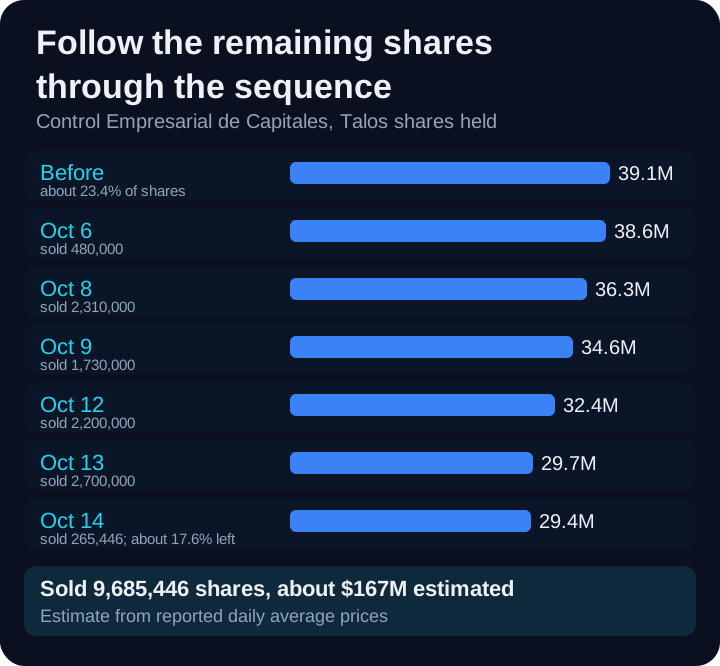
- An October 13 filing reports sales on October 8, 9 and 12.
- An October 15 filing reports sales on October 13 and 14.
These are related disclosures from the same reporting shareholder, not independent selling decisions by six different owners.
The scale of the change
The six sales total 9,685,446 shares. Multiplying each day's reported share quantity by its disclosed average price gives approximately $166.9 million. The rounded description "about $167 million" reflects those reported averages rather than claiming exact net cash proceeds.
Before the sequence, the shareholder held 39,079,036 shares. Afterward it held 29,393,590. Using the company's outstanding-share count cited in the filings, those positions correspond to about 23.4% and 17.6% of Talos respectively.
The proceeds went to the selling shareholder. These market sales did not raise money for Talos or remove money from its balance sheet.
A change to investigate, not a motive to invent
The disclosures establish the sales. They do not establish the seller's complete reasoning or prove that bad company news is coming.
The next questions are specific: do subsequent filings show more reductions, how much of the position remains, and what do Talos's own reports show about its operations and costs?
TradingEdgeIQ's Public Filings Intelligence solution provides a starting point for investigating significant filing activity. In this case, combining related reports makes the pattern clearer than treating every filing as an isolated headline.
The takeaway
The shareholder reduced its stake substantially through a sequence of sales, while retaining a large investment. Both facts belong in the story. Tracking the sequence and the remaining holding is more informative than assuming the estimated dollar amount explains the seller's intentions.
Explore Public Filings Intelligence.
Previous in this series: Elastic: two large sales, and what remained afterward.
Next in this series: Axon: the customer relationship behind a body-camera order.
Research and analytics only. No auto-trading. No financial advice. Historical and simulated results do not guarantee future performance.
Image credit: "Marco Polo at Dusk" by GuavaTrain, via Wikimedia Commons, CC0 1.0. Contextual industry photo; not a Talos Energy facility.
Research and analytics only. No auto-trading. No financial advice. Historical and simulated results do not guarantee future performance.
Related