
Elastic: two large sales, and what remained afterward
Two early-October sales reduced a reported holding by about 58%. Looking at the starting and remaining position gives the dollar headline useful context.
Anuj Saxena · Founder, TradingEdgeIQ
A large share sale gets attention. The more useful question is how much of the seller's reported holding changed.
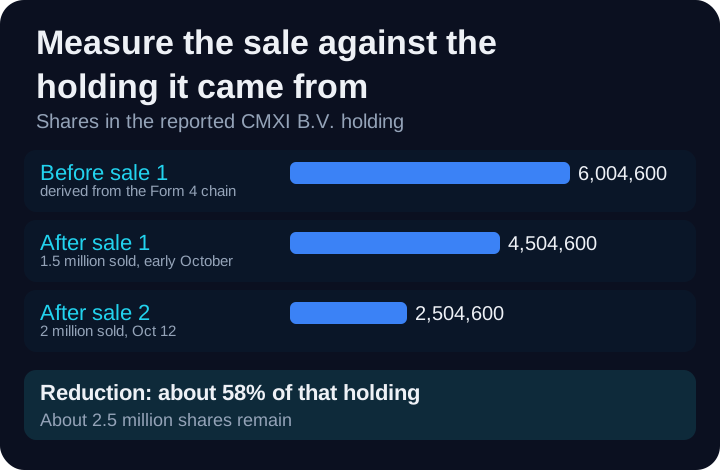
Elastic director Steven Schuurman's filings show two sales through CMXI B.V., a company he controls. Together they involved 3.5 million shares. The reported holding fell from about 6 million shares before the first sale to about 2.5 million afterward, a reduction of approximately 58%.
This article explains that ownership change, the substantial investment that remained, and a discrepancy between source documents that limits how precisely we should describe the proceeds.
Previous in this series: GameStop: Ryan Cohen commits another $22.8 million.
Next in this series: Talos Energy: repeated selling reduced a major holding.
Read the sequence, not one headline
The first Form 4 reports a sale of 1.5 million shares at $90.13, leaving 4,504,600 shares in the reported holding. The second Form 4 reports another 2 million shares sold on October 12 at $94.15, leaving 2,504,600.
The holding therefore contained 6,004,600 shares before those two reductions. Approximately 58.3% of that starting position was sold. The percentage describes this reported CMXI holding; it is not a measure of Schuurman's total wealth or every asset he controls.
Why we use a rounded dollar description
The records do not agree on every detail of the first sale. Its Form 4 gives October 5 and $90.13 a share. A Form 144 notice identifies October 2 and proceeds consistent with $92.25 a share.
Those different inputs produce combined values of approximately $323.5 million or $326.7 million when the second sale is included. The phrase "more than $320 million in early October" remains supported under either version. A single exact combined amount, without explaining the disagreement, would overstate certainty.
This difference does not alter the disclosed share-count sequence used for the approximately 58% reduction.
What selling does not establish
The filings do not establish why the shares were sold. Diversification, cash needs and changes in investment strategy are possible reasons people sell, but we should not assign any of them to this transaction without evidence.
Nor does selling prove that the director expects Elastic's business to weaken. About 2.5 million shares remained in the reported holding after the sales.
For further research, track later ownership disclosures and compare the change with Elastic's operating reports. Keep ownership facts, business performance and assumptions about motive separate.
TradingEdgeIQ's Public Filings Intelligence solution helps direct attention to significant disclosures. Reading related filings together gives a fuller picture than looking only at the largest sale.
The takeaway
The meaningful change is a roughly 58% reduction in a specific reported holding, with substantial shares remaining. The source disagreement calls for careful wording about dates and proceeds. It does not require ignoring the ownership change itself.
Explore Public Filings Intelligence.
Previous in this series: GameStop: Ryan Cohen commits another $22.8 million.
Next in this series: Talos Energy: repeated selling reduced a major holding.
Research and analytics only. No auto-trading. No financial advice. Historical and simulated results do not guarantee future performance.
Image credit: Generated editorial illustration. It does not depict Elastic, its people or its products.
Research and analytics only. No auto-trading. No financial advice. Historical and simulated results do not guarantee future performance.
Related