Rapport Therapeutics: The Buying Broadened After the Trial Results
Approximately $1.66 million of disclosed buying followed public Phase 2 news. The sequence creates a focused question about what comes next.
Anuj Saxena · Founder, TradingEdgeIQ
Generated editorial illustration of laboratory research and a sequence of buyers after a milestone; not a Rapport facility, treatment or clinical result.
The trial results were already public. Then the buying began.
On October 20, 2026, Rapport Therapeutics announced positive Phase 2 results for its investigational treatment for bipolar mania. Over the following three days, purchases associated with its chief financial officer and five directors totaled approximately $1.66 million. The sequence provides a starting point for investigating the next development milestones and the capital required to reach them.
Previous in this series: Applied Digital: $6.66 Million of Insider Buying Meets the Cost of Building AI. Next: Dole: A Major Shareholder Bought More as Operating Pressure Persisted. Each case connects disclosed buying with the business questions behind it.
Start the clock at the public announcement
Rapport reported that its Phase 2 trial of RAP-219 in adults with acute bipolar mania met its primary and key secondary endpoints. It expected to begin Phase 3 trials in this indication in the second half of 2027. The results were a clinical development milestone for an investigational treatment, with further work still ahead. October 20 company announcement.
The buying followed that announcement:
- October 21: CFO Troy Ignelzi bought 5,500 shares for $143,550.
- October 22: purchases associated with directors Steven Paul, John Maraganore, Wendy Young and Paul Silva totaled approximately $1.42 million.
- October 23: director Ramiro Sanchez added approximately $98,478.
Together, the six associated buyers accounted for approximately $1,664,824. Ownership details matter. Steven Paul's approximately $974,278 purchase was through Paul Capital Strategy III Fund LLC. Describing every purchase as a personal check would misrepresent the filings. Paul Form 4, Sanchez Form 4.
The remaining purchase records are the Ignelzi, Maraganore, Young and Silva filings.
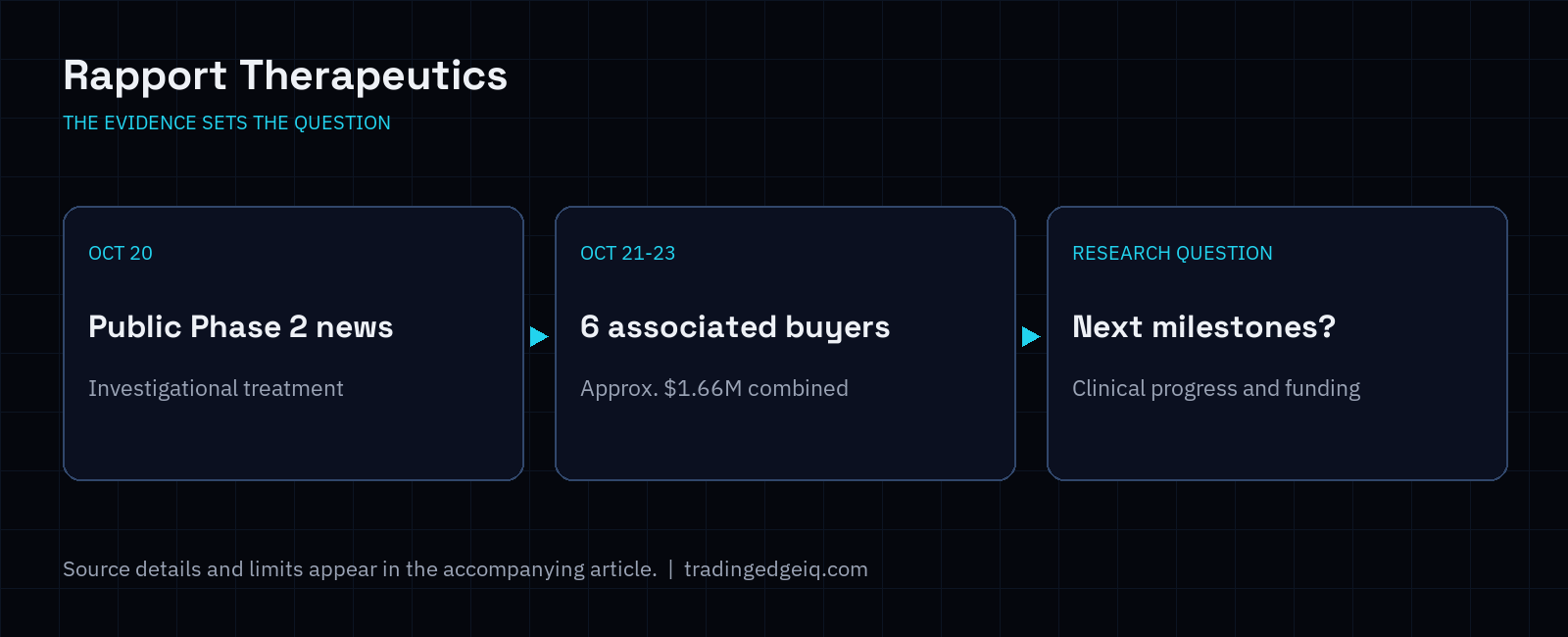
The chronology supports a story about buying after public news. It cannot establish that buyers anticipated undisclosed results.
Broader participation sharpens the question
Several people associated with a company buying during a short period is worth examining. Their participation does not reveal a shared rationale, guarantee later clinical results or establish the eventual commercial opportunity.
The investment question becomes: what must Rapport accomplish between a promising Phase 2 announcement and a viable treatment business?
An investor can make that question practical by examining the trial's design and limitations, later development requirements, the funding needed to complete them, and the competitive setting. Management's expected Phase 3 timing provides a future checkpoint. An expected start date is still a plan.
Follow the evolving cluster
TradingEdgeIQ's Public Filings Intelligence brought the purchases together and updated the alert when another buyer joined. The October 22 and October 23 messages concerned one evolving cluster. Adding both headline totals would double-count activity already included in the earlier message.
That continuity is the useful product contribution. A new filing can expand an existing research case, and the investor can see what changed.
The product's Evidence Confidence concerns the filing evidence. It should never be interpreted as a probability of clinical success or an estimate of investment return.
Use the buying to define the next checkpoint
The case establishes a public clinical announcement followed by broader disclosed buying. It creates a reason to study Rapport's next steps while leaving their outcome open.
The strongest follow-up question is therefore concrete: which clinical and funding milestones would need to be met before the investment thesis becomes stronger?
Return to Applied Digital: $6.66 Million of Insider Buying Meets the Cost of Building AI to compare a different expansion challenge. Continue to Dole: A Major Shareholder Bought More as Operating Pressure Persisted, where understanding the buyer's ownership structure becomes central.
Explore Public Filings Intelligence.
Research and analytics only. No auto-trading. Not financial advice. RAP-219 is investigational; the cited Phase 2 announcement does not establish approval. Evidence reviewed as of October 25, 2026.
Research and analytics only. No auto-trading. No financial advice. Historical and simulated results do not guarantee future performance.
Related