Dole: A Major Shareholder Bought More as Operating Pressure Persisted
A Pale Fire investment vehicle bought approximately $8.55 million of Dole shares. The filing leads to a question about costs, operating performance and ownership.
Anuj Saxena · Founder, TradingEdgeIQ
Generated editorial illustration of produce crates in a warehouse aisle; not a Dole facility.
You recognize the name on the fruit. A major shareholder's new buying gives you a reason to examine the business behind it.
A Pale Fire investment vehicle purchased approximately $8.55 million of Dole shares across October 20, 21 and 22, 2026. The interesting tension is that this accumulation followed company results showing revenue growth alongside pressure on adjusted operating performance. This case connects the ownership evidence with the question of whether selling more produce can deliver better economics.
Previous: Rapport Therapeutics: The Buying Broadened After the Trial Results. Next: Quest Diagnostics: The Business Behind a $902,000 Laboratory Order, which follows a different kind of disclosure into an operating business.
Reconstruct the purchase before interpreting it
The Form 4 reports three purchase dates:
- October 20: 45,676 shares at a weighted average of $13.2364.
- October 21: 438,900 shares at a weighted average of $13.1166.
- October 22: 163,780 shares at a weighted average of $13.3896.
That is 648,356 shares, approximately $8,554,410 using the filed prices, and a resulting reported holding of 10,282,620 shares. Dole Form 4 and ownership footnotes.
Five reporting names appear in the ownership structure. They represent related beneficial owners associated with the same economic purchase. Counting those names as five independent investors would exaggerate the breadth of buying.
The filing establishes increased exposure. It does not explain Pale Fire's reasoning or establish a takeover plan.
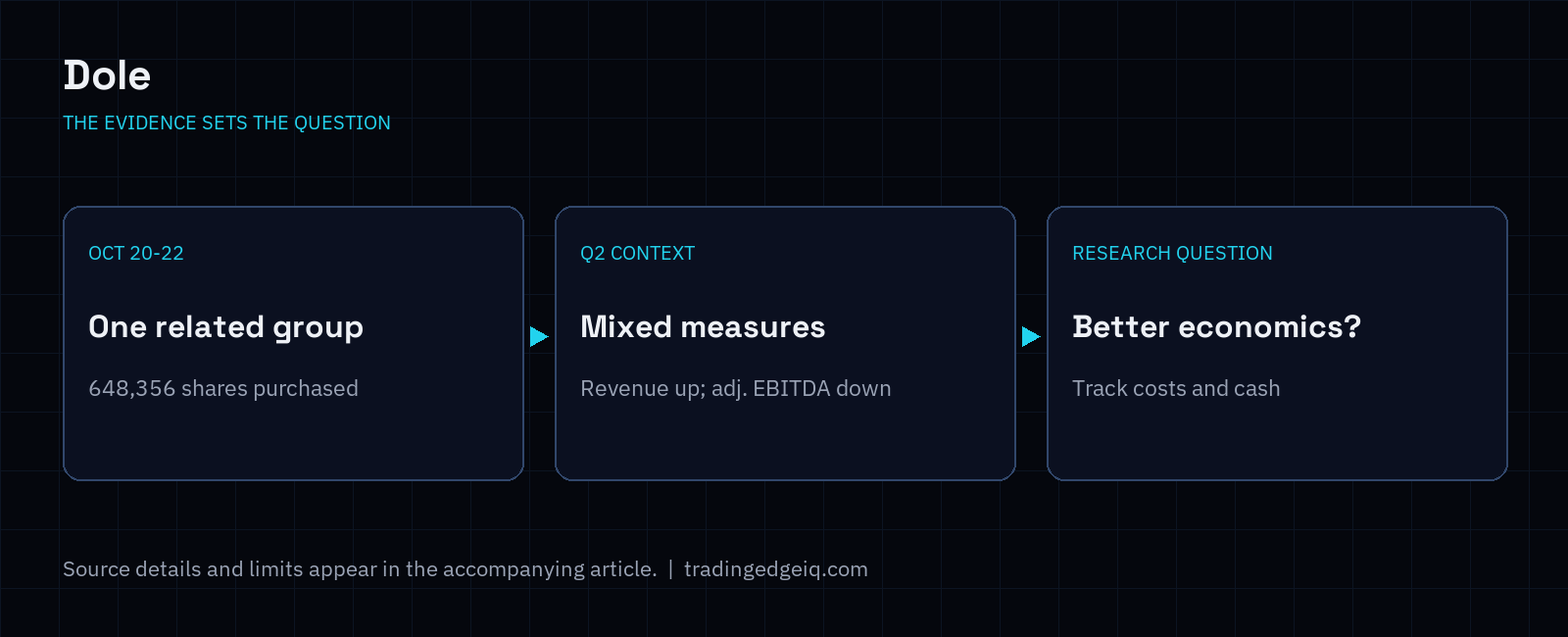
The dates add up to one accumulation story. The ownership names should not multiply its size or apparent participation.
Sales and earnings measures tell different stories
Dole's August 10 report for the quarter ended June 30 showed revenue growing 2.9%. Adjusted EBITDA fell 14.8%, from $137.1 million to $116.8 million, with higher fruit-sourcing costs affecting performance. Yet reported net income rose from $18 million to $35.1 million. Second-quarter 2026 company results.
Those measures answer different questions. Adjusted EBITDA is a non-GAAP measure with company-defined adjustments. Net income reflects a different set of items. Neither should be substituted for cash flow.
This is why the case needs a more precise question than whether profits are simply rising or falling: can Dole turn growing sales into stronger underlying operating performance while managing costs?
The quarterly results are business background from August. They should not be presented as a new announcement accompanying October's purchases.
Make the tension testable
An investor researching the case can track sourcing costs, segment performance and cash generation in later reports. If costs improve, does the benefit reach operating results? If revenue grows, how much additional working capital does the business require?
The buyer's increased exposure makes those questions interesting. It does not settle them.
TradingEdgeIQ's Public Filings Intelligence surfaced the purchase records. Reading the full original filing supplied the complete three-day sequence and the related ownership structure. The research benefit is a clear route from a disclosed transaction to a focused examination of the business.
Read the purchase and the operating statement together
Dole's case establishes meaningful accumulation by one related shareholder group against a mixed operating backdrop. It also shows why a strong research narrative must preserve differences between revenue, adjusted EBITDA, net income and cash.
The question to carry forward is: which operating measure would need to improve before the business evidence begins to support the optimism an observer might infer from the buying?
Compare the widening participation in Rapport Therapeutics: The Buying Broadened After the Trial Results. Then continue to Quest Diagnostics: The Business Behind a $902,000 Laboratory Order, where a contract makes customer demand tangible.
Explore Public Filings Intelligence.
Research and analytics only. No auto-trading. Not financial advice. Evidence reviewed as of October 25, 2026; purchase amounts are approximate where filed weighted-average prices are used.
Research and analytics only. No auto-trading. No financial advice. Historical and simulated results do not guarantee future performance.
Related