
Neighborhood Intelligence: Can Familiar Brands Become a Profitable Business?
Marcus Lemonis bought approximately $1 million of newly issued shares. The research question is whether recognizable home brands can become a profitable connected business.
Anuj Saxena · Founder, TradingEdgeIQ
Generated editorial illustration of home-related storefronts connected along a neighborhood street; not an actual Neighborhood Intelligence property.
You know the brands: Bed Bath & Beyond, Overstock and The Container Store. The investment question is whether bringing familiar names together can create a profitable business.
Marcus Lemonis put approximately $1 million into Neighborhood Intelligence on October 6, 2026, buying newly issued shares. This case follows that commitment into the company's retail turnaround, where returning revenue growth sits alongside losses and the need to integrate the businesses.
The test is whether customer familiarity can become better margins and cash generation before additional financing dilutes more of the shareholders' upside.
Previous: Quest Diagnostics: The Business Behind a $902,000 Laboratory Order. Continue around this five-case series to Applied Digital: $6.66 Million of Insider Buying Meets the Cost of Building AI, which examines another business funding expansion.
Follow the money into the company
Lemonis purchased 362,319 newly issued shares at $2.76 each, a commitment of approximately $1,000,000. His resulting reported holding was 1,076,860 shares. The transaction formed part of a financing effort and closed on October 6. Lemonis Form 4, company financing 8-K.
The transaction type changes its meaning. Buying newly issued shares puts money into the company and expands its share count. A secondary-market purchase changes ownership between investors. Both increase a buyer's exposure, but their effects on company funding differ.
The purchase is an October 6 event being examined as a turnaround case. It should not be presented as new buying during October 19–25.
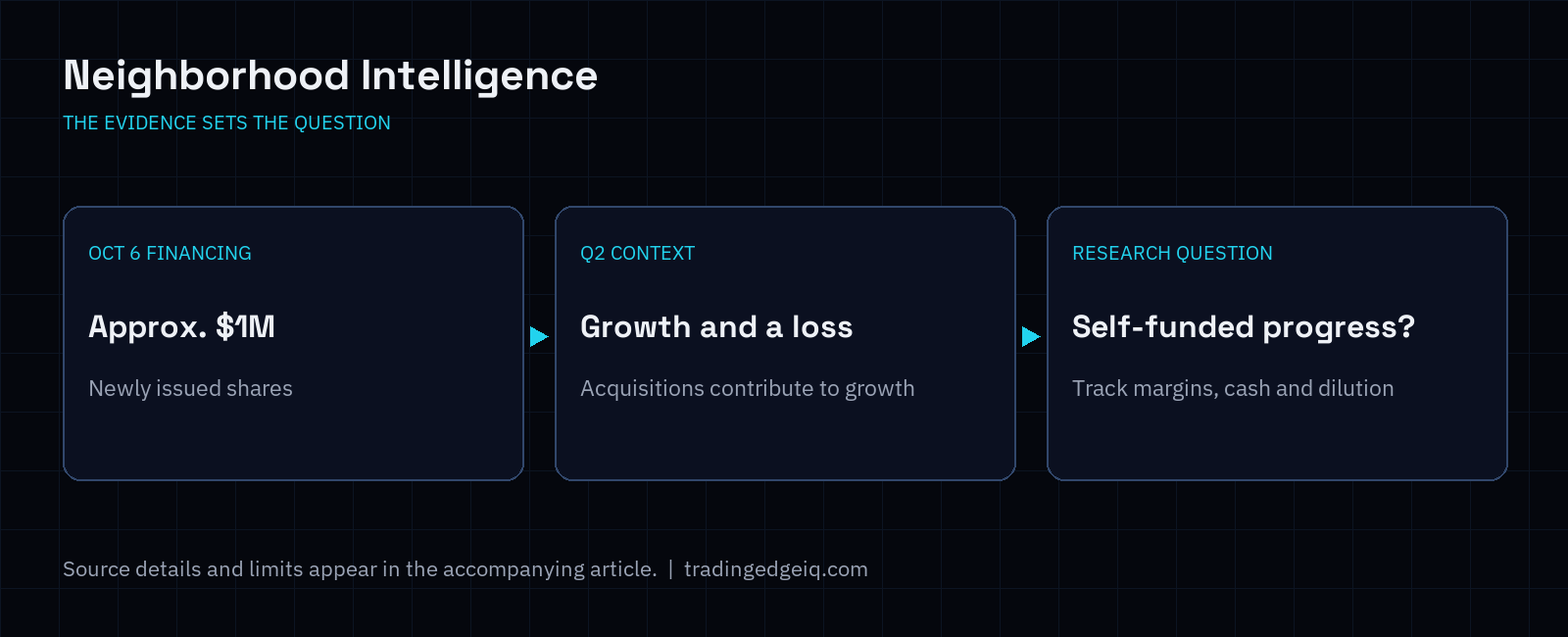
The purchase supports the company financially. The operating challenge is to turn that capital and those brands into a business that needs less external funding.
Growth has returned. Profitability still needs work.
Neighborhood's strategy connects home retail with services and homeownership. The ambition is a broader relationship with customers as they furnish, improve and manage their homes.
There is evidence of progress. Second-quarter revenue reached $361.159 million, up 28% year over year. This was the second consecutive quarter of growth after nineteen quarters of revenue decline. Acquisitions contributed to the increase, so the headline percentage should not be described as entirely organic growth. The quarter also produced a $39.497 million net loss. Second-quarter company results.
In its October 5 update, management said gross margin was expected to exceed 30%. It prioritized integration, cost reduction and organic growth, with no additional acquisitions anticipated at that time. These were management expectations and priorities, with execution still to be demonstrated. October business update.
What would demonstrate a working turnaround?
The investment question is concrete: can the combined businesses become profitable before further funding takes a larger share of the eventual upside?
An investor can track organic revenue separately from acquired revenue, examine whether gross-margin improvements survive operating costs, and compare cash use with available funding. Integration progress matters only insofar as it improves the customer proposition or the economics.
Lemonis's commitment gives that work a focal point. It does not establish the eventual value of the brands or the success of the strategy.
TradingEdgeIQ's Public Filings Intelligence surfaced the purchase. Following the filing into the financing terms and operating results supplies the essential context: what the insider bought, where the money went and which business measures deserve attention next.
Brand recognition opens the story. Execution decides it.
This case establishes a financing commitment by Lemonis, renewed revenue growth and a continuing loss. Together, those facts define a research plan centered on integration, margins, cash use and dilution.
The question to revisit with each update is: is the company becoming better at funding its own progress?
Compare the defined service relationship in Quest Diagnostics: The Business Behind a $902,000 Laboratory Order. Then return to Applied Digital: $6.66 Million of Insider Buying Meets the Cost of Building AI to consider how a very different expansion story faces its own financing test.
Explore Public Filings Intelligence.
Research and analytics only. No auto-trading. Not financial advice. Evidence reviewed as of October 25, 2026. Management expectations are forward-looking and may not be achieved.
Research and analytics only. No auto-trading. No financial advice. Historical and simulated results do not guarantee future performance.
Related