Applied Digital: $6.66 Million of Insider Buying Meets the Cost of Building AI
Two executive purchases sharpen the question facing Applied Digital: can expanding AI infrastructure produce durable shareholder earnings?
Anuj Saxena · Founder, TradingEdgeIQ
Generated editorial illustration of a data-center aisle with illuminated server racks; not an Applied Digital facility.
The executives building AI infrastructure have put more of their own money into the company. The investment question is whether the facilities they are building can turn demand for computing into durable earnings.
Applied Digital's CEO and president purchased a combined $6.66 million of shares on October 16, 2026. This case follows those purchases into the company's capacity expansion and financing needs. The useful connection is between management's financial commitment and a business whose economics still need to develop.
In this case-study series: the previous case, Neighborhood Intelligence: Can Familiar Brands Become a Profitable Business?, examines a different capital commitment. Next, Rapport Therapeutics: The Buying Broadened After the Trial Results, considers the sequence after public news.
Two filings, one business question
CEO and chairman Wes Cummins reported buying 55,803 shares at $18.04, approximately $1.01 million. President Jason Gechen Zhang reported buying 300,000 shares at a weighted average of $18.86, approximately $5.66 million. Both filings became public on October 19. Using the filed prices, their combined purchases total $6,664,686.12. Cummins Form 4, Zhang Form 4.
Two operating leaders increasing their exposure creates a concrete reason to investigate. It does not disclose their motives or establish what the shares are worth.
The timing matters, too. The company's operating update preceded the purchases. Readers can assess the buying against information already available to the market.
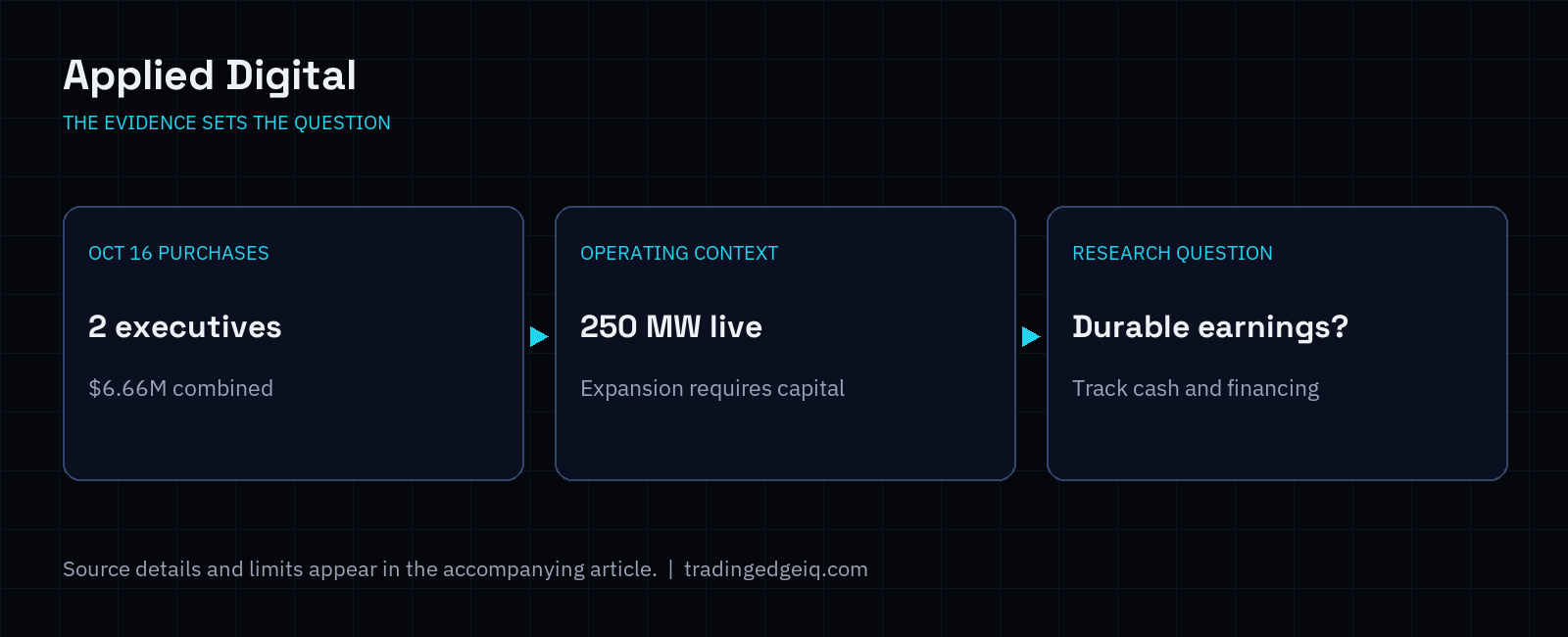
The two purchases establish a financial commitment. Capacity, financing and earnings determine the business question that follows.
Buildings need more than demand
Applied Digital develops infrastructure for high-performance computing. Its opportunity depends on delivering powered facilities and converting that capacity into attractive economics over time.
In its October 7 results, the company reported $341.9 million of quarterly revenue and a $221 million net loss from continuing operations attributable to common stockholders. Polaris Forge 1 reached 250 megawatts of operating capacity after an October 1 delivery. The release also described $1.59 billion of 7% secured notes. These figures show both the scale of expansion and the financing commitments supporting it. Fiscal first-quarter 2027 results.
For shareholders, more capacity creates an opportunity that must be weighed against construction spending, financing costs and the timing of customer payments. Revenue growth alone cannot answer whether the expansion will produce durable earnings.
What would make the thesis stronger?
A useful research plan starts with three questions:
- Does newly delivered capacity produce sustained customer revenue, and how does that revenue translate into cash?
- What further spending and financing are required before the planned facilities are complete?
- After operating and financing costs, what economics remain for common shareholders?
Those are questions for subsequent disclosures. The purchases themselves do not answer them.
TradingEdgeIQ's Public Filings Intelligence connected the two executives' purchases in a research cluster. Following that connection into the original filings and operating results makes the task more focused: examine the commitment alongside the economics of the business receiving it.
The commitment is documented. The economics remain the test.
Applied Digital provides a clear example of how insider buying can improve a research process. Two separate filings establish meaningful purchases by operating leaders. The company's own results establish the expansion, losses and financing that deserve attention next.
The question to carry forward is specific: what evidence would show that additional megawatts are becoming additional value for shareholders?
Compare the financing purchase in the previous case, Neighborhood Intelligence: Can Familiar Brands Become a Profitable Business?. Then continue to Rapport Therapeutics: The Buying Broadened After the Trial Results, where the chronology changes what the buying can tell us.
Explore Public Filings Intelligence.
Research and analytics only. No auto-trading. Not financial advice. Events and evidence reviewed as of October 25, 2026; later developments are outside this case.
Research and analytics only. No auto-trading. No financial advice. Historical and simulated results do not guarantee future performance.
Related