
Pershing Square USA: follow the $9.6 million purchase sequence
Ryan Israel bought shares on three dates. Follow the purchases and resulting holding to understand how his investment changed.
Anuj Saxena · Founder, TradingEdgeIQ
A $9.6 million purchase headline compresses a sequence of buying into one number. Following the dates shows how the investment grew.
Ryan Israel, chief investment officer of Pershing Square USA, bought shares on October 2, 5 and 6, 2026. The filing reports 256,613 shares acquired, taking his disclosed holding to 756,613 shares.
What does that sequence tell an investor? This case shows how purchase dates and the resulting holding provide a clearer picture of changing exposure.
Previous in this research collection: Corebridge: a $21 million purchase under an earlier plan.
Continue with: Gogoro: where does the $35 million of buying money go?.
First, understand what he bought
Pershing Square USA is an investment company whose own shares trade on the stock exchange. Buying its shares is an investment in that vehicle. Understanding the vehicle and its assets is part of the next research step.
The SEC Form 4 identifies Israel’s role and reports purchases of 78,138 shares on October 2, 120,816 on October 5 and 57,659 on October 6. Together they total 256,613 shares. The disclosed purchase prices produce an approximate value of $9,615,215.58.
Follow the change in the investment
The ending balance of 756,613 shares is a different figure from the 256,613 shares acquired. One describes the disclosed holding after the purchases; the other describes the additions covered by those purchase rows.
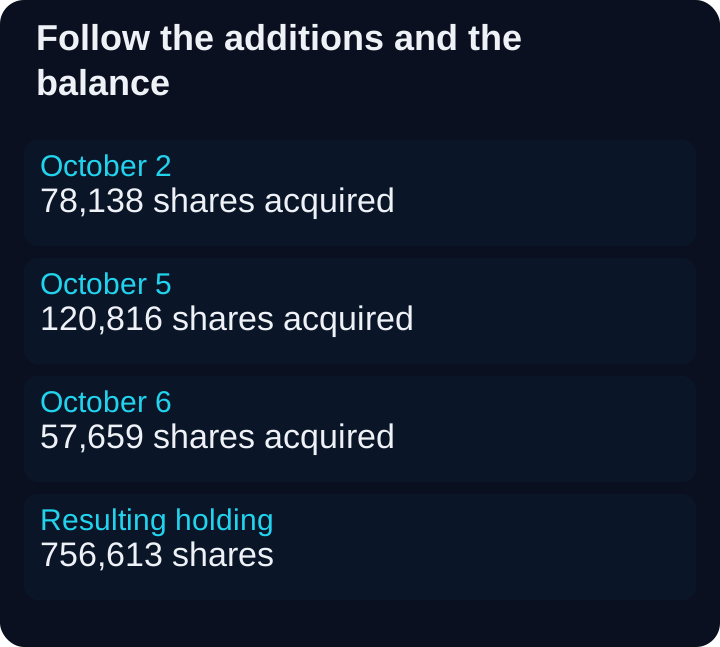
That distinction is easy to lose when separate transactions become one buying headline. The sequence gives you a concrete observation: the same person added to his investment over several dates. It should not become a claim of three independent buyers or three separately verified decision processes.
Growing exposure and attractive valuation are separate questions
An increase in someone’s investment is useful evidence of changed exposure. Determining whether the shares offer attractive value requires more work. You would examine the investment vehicle, its assets and the price available to you.
The purchase sequence helps decide what deserves attention. It does not replace that valuation research. That makes the next step clearer: understand the vehicle well enough to evaluate the investment on your own criteria.
How TradingEdgeIQ helps
Public Filings Intelligence brings purchase dates, quantities and resulting-share fields into your research. Instead of reconstructing the sequence from isolated headlines, you can follow the reported activity and then inspect the underlying filing.
The practical benefit is a clearer view of how a person’s investment changed over time. That supports a better-informed judgment about which activity merits closer investigation.
Read the additions and the balance together
This case establishes purchases over three dates, approximately $9.6 million of reported additions and a resulting holding of 756,613 shares. The lesson is to follow the sequence while keeping the amount bought separate from the amount held.
The next case asks where purchase money goes when the company issues new shares. How can a financing strengthen the business while changing existing owners’ percentages?
TradingEdgeIQ helps you find meaningful signals sooner, research them more thoroughly, and make better-informed investment decisions. Explore Public Filings Intelligence.
Previous in this research collection: Corebridge: a $21 million purchase under an earlier plan.
Continue with: Gogoro: where does the $35 million of buying money go?.
Image credit: Generated editorial concept image. It does not depict a verified company property, product or transaction.
Research and analytics only. No auto-trading. No financial advice. Historical and simulated results do not guarantee future performance.
Related