
Gogoro: where does the $35 million of buying money go?
Gogoro announced investor-linked commitments within a $61.8 million financing. Learn how new shares change funding and ownership.
Anuj Saxena · Founder, TradingEdgeIQ
About $35 million of investor-linked buying commitments sounds encouraging. The next question is where the money would go.
Gogoro’s October 7, 2026 announcement places those commitments inside an approximately $61.8 million equity financing involving newly issued shares. At the approved video’s October 10 research cutoff, funding remained subject to closing conditions.
How is that different from buying stock on the exchange? This case explains the cash destination, the additional shares and what those changes mean for an existing shareholder.
Previous in this research collection: Pershing Square USA: follow the $9.6 million purchase sequence.
Continue with: Marvell: follow the issue behind a $50,000 lobbying report.
What Gogoro announced
The issuer’s SEC filing and accompanying announcement describe 24,936,057 new shares at $2.48 each. Gold Sino and Peng-Lin, two Yin-controlled entities, committed to 10,692,681 and 3,466,310 shares respectively. Together, those commitments represent 14,158,991 shares, or approximately $35,114,297.68.
The announcement expected remittance by October 13, subject to customary closing conditions including Nasdaq clearance. This article discusses the announced commitments rather than treating them as completed funding. The same distinction remains appropriate in the October 11 source review.
Existing shares and new shares send money to different places
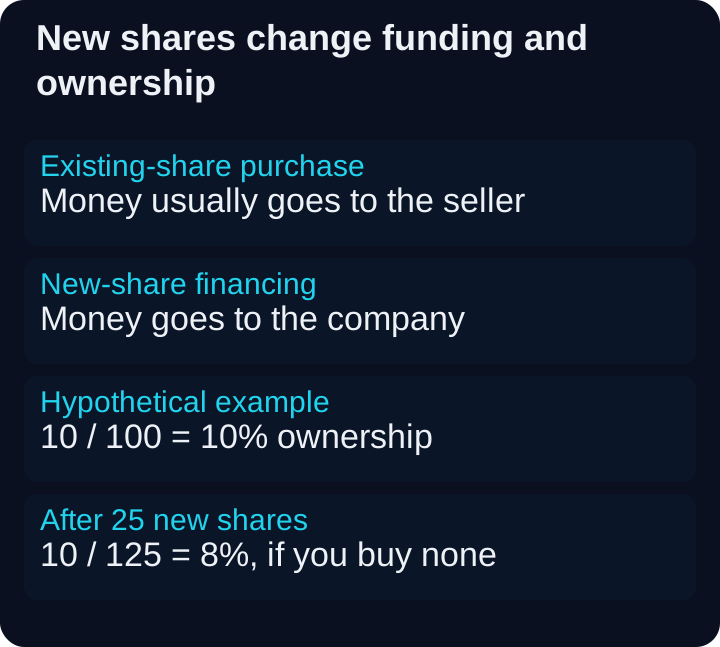
When you buy an existing share on the stock market, your payment usually goes to the seller. The company generally receives no new funding from that transaction.
When an investor buys newly issued shares from the company, the company receives funding. It also creates additional shares. The research now concerns financing terms, the business’s use of the money and the ownership changes.
What dilution means
Imagine a company has 100 shares and you own 10. You own 10% of the total. It issues another 25 shares, and you buy none. You still own 10 shares, but your ownership percentage becomes 10 out of 125, or 8%.
That reduction in percentage ownership is called dilution. This example explains the concept; it is not a calculation of actual Gogoro dilution.
The company also receives new money in the financing. Evaluating whether the transaction benefits existing shareholders requires examining the terms and what the business does with the funding. The ownership percentage is one part of that assessment.
How TradingEdgeIQ helps
The Public Filings Intelligence alert brought attention to the activity. Reading the company’s financing announcement supplied the context needed to interpret it. The alert and source research together turn a large buying headline into better questions about funding and ownership.
The entities’ shared control also matters. Several entity names should not automatically become several independent buyers in your interpretation.
Follow the money and the ownership
This case establishes announced commitments within a larger financing, newly issued shares and conditional closing. The lesson is to evaluate the company’s funding and the changes in ownership together.
Next, follow another kind of company activity: what can a lobbying report reveal about a specific technology and policy issue?
TradingEdgeIQ helps you find meaningful signals sooner, research them more thoroughly, and make better-informed investment decisions. Explore Public Filings Intelligence.
Previous in this research collection: Pershing Square USA: follow the $9.6 million purchase sequence.
Continue with: Marvell: follow the issue behind a $50,000 lobbying report.
Image credit: Generated editorial concept image. It does not depict a verified company property, product or transaction.
Research and analytics only. No auto-trading. No financial advice. Historical and simulated results do not guarantee future performance.
Related