
Corebridge: a $21 million purchase under an earlier plan
Nippon Life bought Corebridge shares in October under a plan adopted in August. Learn why the trade date and decision date can differ.
Anuj Saxena · Founder, TradingEdgeIQ
A $21 million purchase happens in October. The arrangement behind it dates back to August.
Nippon Life bought 606,912 Corebridge shares on October 7, 2026. At the disclosed weighted-average price of $34.4038, that amounts to approximately $20.9 million. The filing also identifies a trading plan adopted on August 7.
Does the October purchase show a new decision in response to this week’s news? This case explains why the transaction date and the earlier plan date belong in the same research picture.
Previous in this research collection: Neighborhood Intelligence: the extra benefit the CEO declined.
Continue with: Pershing Square USA: follow the $9.6 million purchase sequence.
Start with the purchase, then read the footnote
The SEC Form 4 reports the acquisition and describes the earlier Rule 10b5-1 trading plan. The disclosed price and share quantity produce an approximate purchase value of $20,880,079.07.
Nippon Life acquired those shares. The plan detail adds context to the buying; it does not erase the transaction.
A trading plan arranges activity in advance
In plain English, a trading plan can arrange future purchases or sales under specified conditions. The plan can therefore be established before a later transaction executes.
Think of setting up a future payment. Seeing the payment leave your account today does not mean you decided to make it this morning. In the same way, a stock trade can occur today under an arrangement made earlier.
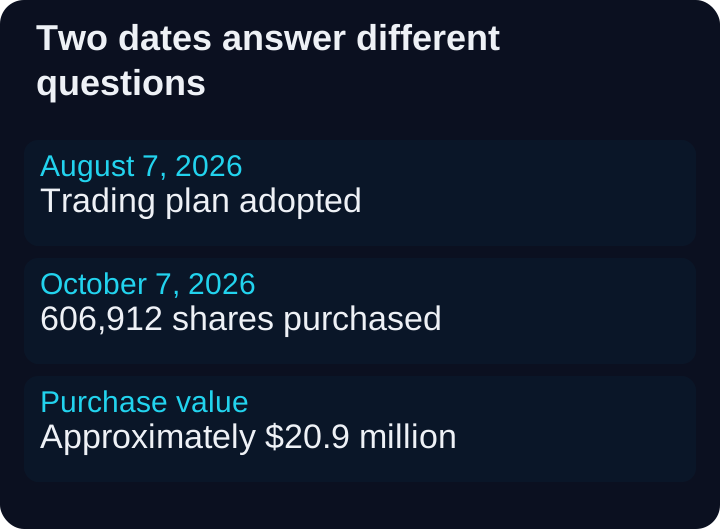
For this case, the source supports two distinct dates: August 7 for adoption of the plan and October 7 for the purchase. That distinction changes the answer to the opening question. The purchase alone does not establish that new October news prompted a fresh buying decision.
Ask what the evidence can tell you
An investor can investigate the purchase amount, the resulting ownership and the disclosed plan. Additional research might examine the relationship between the investor and the company and the plan’s disclosed terms. The footnote gives you a better starting point for those questions.
Reading the purchase as an execution under an earlier plan is more precise than treating every large trade as an immediate reaction to the latest headline.
How TradingEdgeIQ helps
Public Filings Intelligence’s transaction record identifies the earlier plan, consistent with the filing. Having that detail alongside the reported purchase helps you distinguish an existing arrangement from a possible fresh decision.
You spend less time treating the headline as the whole story and more time evaluating what the evidence means for your research. The filing remains the source for the terms and dates.
Keep both dates in view
The case establishes a substantial October acquisition under a plan adopted in August. The useful lesson is to examine transaction timing and decision arrangements together.
The next case follows several purchase dates and a resulting share balance. How much did the individual’s investment actually grow?
TradingEdgeIQ helps you find meaningful signals sooner, research them more thoroughly, and make better-informed investment decisions. Explore Public Filings Intelligence.
Previous in this research collection: Neighborhood Intelligence: the extra benefit the CEO declined.
Continue with: Pershing Square USA: follow the $9.6 million purchase sequence.
Image credit: Generated editorial concept image. It does not depict a verified company property, product or transaction.
Research and analytics only. No auto-trading. No financial advice. Historical and simulated results do not guarantee future performance.
Related