
Grab's CEO bought nearly $30 million. Its president bought too.
Two senior executives reported about $30.7 million of purchases. Those completed transactions tell a different story from a corporate buyback authorization.
Anuj Saxena · Founder, TradingEdgeIQ
Grab's CEO bought nearly $30 million of company shares on September 21. Its president and chief operating officer separately bought almost $867,000 on the same day. Together, the filings report approximately $30.7 million of completed executive purchases.
This case shows why personal purchases and a corporate buyback authorization need separate treatment, even when both appear in the same investment story. Previously, CrowdStrike's eight sale rows examined ownership and plan context. Next, the prop-firm challenge case explores another consequential distinction: profitability versus compatibility with account rules.
Situation: improving reported growth preceded the purchases
Grab operates ride-hailing, delivery and financial services across Southeast Asia. Its August 4 second-quarter release reported 22% year-over-year revenue growth, raised full-year guidance and announced a $750 million share repurchase authorization.
Those are business and capital-allocation developments. An authorization permits repurchases; it does not show that the entire amount has already been spent. A researcher should keep the authorization separate from executed transactions when assessing the scale of actual buying.
Complication: two executives then reported personal purchases
CEO Anthony Tan's Form 4 reports 10,350,000 shares acquired on September 21 at a weighted-average price of $2.8866. Multiplying the reported figures gives approximately $29,876,310.
President and COO Alexander Hungate's separate Form 4 reports 299,571 shares at $2.8936 on the same transaction date. That produces approximately $866,839. The combined calculated gross value is approximately $30,743,149, using reported weighted-average prices.
These are two reporting people and completed disclosed acquisitions. They should not be added to the entire corporate authorization to produce an exaggerated total of executed buying.
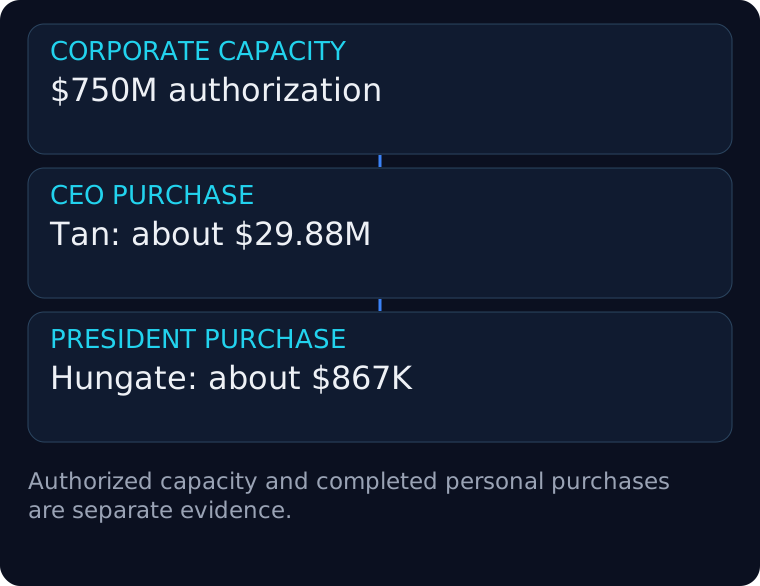
The $750 million figure is authorized corporate capacity. The approximately $30.7 million figure is the calculated value of the two reported executive purchases. They are not interchangeable.
Question: what does the combination add to research?
The CEO's transaction draws attention because of its size. The president's purchase adds breadth because it comes from another senior executive. The recent business release supplies a question to investigate: how do operating growth, guidance and capital allocation fit with the investment case?
The answer requires more than insider activity. A researcher still needs to examine earnings quality, cash generation, competitive conditions and valuation. The purchase records do not disclose a complete thesis, prove the stock is undervalued or establish that the two executives coordinated their decisions.
Keeping the evidence categories separate makes that review easier. Corporate capital allocation belongs in one part of the assessment. Executives' disclosed changes in exposure belong in another. Both may inform the investigation, but they carry different implications and different limits.
Resolution: compare the filings without losing their meaning
Public Filings Intelligence brings reported amounts, holdings and original filing footnotes into one research workflow. It reduces the effort of locating source records and checking how the transaction details fit together.
For Grab, the practical result is a clearer starting point: two executives bought on the same reported day, while the company had separately announced a repurchase authorization and stronger guidance. That organized evidence helps a researcher decide what deserves more attention. This article does not claim a historical alert, a particular score or an automatically generated valuation conclusion.
What this proved
Grab's two senior-executive purchases are a substantial research lead. Their meaning becomes clearer when completed personal transactions are distinguished from permission for future corporate repurchases. The lesson is to improve the evidence record before expanding the investment story.
Return to CrowdStrike's eight sale rows for the ownership distinction. Continue to the prop-firm challenge case to examine how a strong result can still fail a different set of requirements.
Image credit
Cover: Chainwit, Grab HQ at one-north, Singapore, March 17, 2025, CC BY 4.0. Cropped and resized. The photograph supplies company context; it does not depict the purchases. No endorsement implied.
Research and analytics only. No auto-trading. No financial advice. Historical and simulated results do not guarantee future performance.
Related