
Truist’s CEO Bought $1.2 Million. Was It Compensation?
Truist CEO Michael Lyons purchased 25,000 common shares. His Form 4 separates that buy from restricted stock units.
Anuj Saxena · Founder, TradingEdgeIQ
The bank and filing card represent the transaction review. This is not the original Truist form.
One filing separates a share purchase from restricted stock.
An executive’s Form 4 can contain more than one kind of transaction. Truist CEO Michael Lyons reported buying common shares on October 28, 2026. The same filing also reports restricted stock units. Counting the two together would obscure what he actually purchased.
In this series: NASA’s test-rig order comes before this case. Next is MSC Industrial’s Jacobson purchase.
Read the purchase row
Lyons bought 25,000 common shares at $48.362 each, a reported outlay of $1,209,050. The filing shows 46,000 common shares held directly after the transaction. It separately lists restricted stock units; those units are not part of the 25,000-share open-market purchase. Lyons Form 4.
The title matters because Lyons became Truist’s CEO on August 31, 2026, according to the company’s quarterly filing. The acquisition therefore increased the direct common-share exposure of the person leading the bank. It does not reveal his reason for buying or predict how Truist shares will trade.
TradingEdgeIQ’s Public Filings Intelligence recorded the purchase as a high-relevance event and a notification was marked sent. Its value here is to surface the filing quickly enough for a researcher to inspect the transaction code, ownership type and separate compensation lines. We do not infer that any subscriber traded on the alert.
What should investors investigate next?
The filing establishes a decision by the CEO; the investment case still depends on the bank. Investors can examine loan quality, deposit costs, net interest income, capital and management’s execution against subsequent quarterly results. None of those outcomes is established by the share purchase.
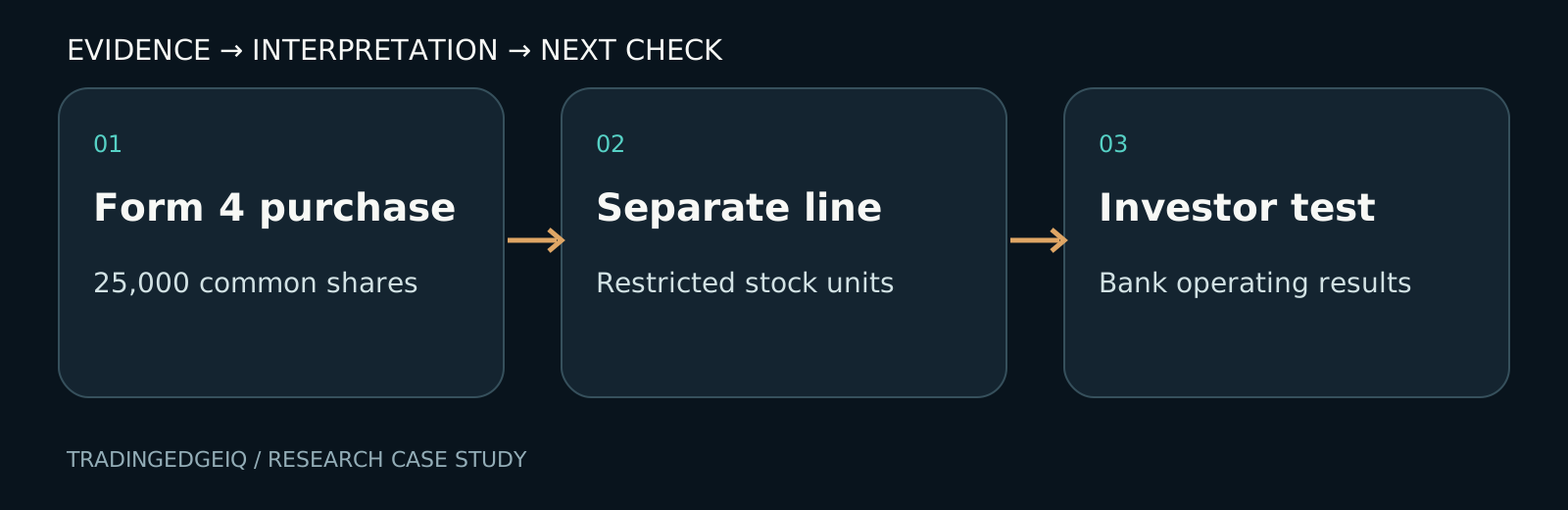
The purchased common shares and compensation units are different disclosures; bank results remain the investment test.
Three takeaways for traders and investors
- Separate cash buying from compensation. The 25,000 common shares were purchased; restricted stock units are a different line.
- Check the officer and ownership context. Lyons was the CEO and held 46,000 common shares directly after the transaction.
- Use the signal to start focused research. Public Filings Intelligence surfaced a sent purchase event; the Form 4 and bank disclosures provide the evidence needed to assess its significance.
The strongest conclusion is narrow and useful: the CEO increased his direct common-share position, giving investors a concrete filing to investigate alongside Truist’s operating results.
Compare NASA’s government-order verification, then continue to MSC Industrial’s multi-row filing, where aggregation is the central challenge.
Explore Public Filings Intelligence.
Research and analytics only. No auto-trading. Not financial advice. Evidence reviewed November 1, 2026.
Research and analytics only. No auto-trading. No financial advice. Historical and simulated results do not guarantee future performance.
Related