
MSC Industrial’s $29 Million Buy: What Counts as a Purchase?
Three direct purchase rows total 250,000 shares. A separate trust gift requires careful transaction and ownership accounting.
Anuj Saxena · Founder, TradingEdgeIQ
Three inventory boxes and a separate gift symbol represent the distinct filing rows. This is not an MSC warehouse or filing.
Three direct purchase rows and one separate gift demand careful accounting.
An insider filing can make one ownership event look like several independent signals. MSC Industrial’s Mitchell Jacobson reported three direct purchase rows on October 23, 2026. Read together, they represent 250,000 shares bought for about $28.98 million using the filing’s reported weighted prices. A separate gift line should not be added to that purchase.
In this series: Truist’s CEO purchase comes before this case. Next is Xylem’s director purchase after revised guidance.
Reconcile the rows before telling the story
The three direct purchase rows total 250,000 shares and $28,984,169.74. The same Form 4, filed October 27, also reports an 8,200-share indirect trust gift coded G. The gift is not another buy, and it is not a reason to silently reduce the direct purchase total. It has a different transaction code and ownership form.
TradingEdgeIQ’s Public Filings Intelligence retained a high-relevance purchase event for research. We did not verify a sent customer notification, so the product claim here is about the retained observation and the analyst’s ability to work from it. The filing itself supplies the transaction detail.
Size creates a question, not an answer
The reported purchase is sizable. It establishes Jacobson’s increased direct share exposure but says nothing definitive about his motive, MSC Industrial’s future operating results or the stock’s fair value. Investors can review company demand, customer activity, margins and capital allocation in subsequent disclosures before deciding whether the purchase changes their thesis.
The important method is to reconcile every row before making that judgment. A headline based on four rows as four purchases would exaggerate the activity. A headline that nets the gift against the buys without explaining ownership would create a different distortion.
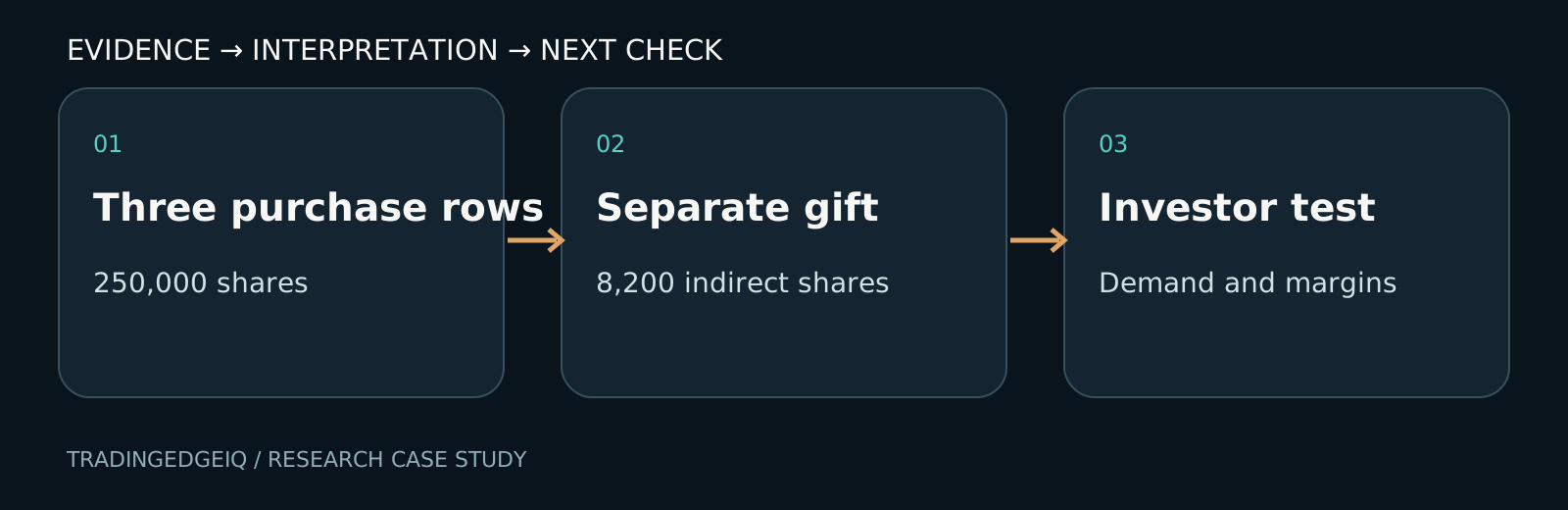
Aggregating purchases once and separating the gift creates a clean ownership picture for further research.
Three takeaways for traders and investors
- Aggregate like transactions once. The three direct purchase rows add to 250,000 shares and approximately $28.98 million.
- Keep other codes separate. The 8,200-share indirect gift is a distinct event and ownership category.
- Turn a large filing into a research plan. Public Filings Intelligence can prioritize the purchase; the source filing and later operating results determine what it means.
The useful signal is a verified purchase with a clean denominator and an explicit question about business performance.
Read Truist’s compensation-versus-purchase case, then continue to Xylem’s mixed-results case.
Explore Public Filings Intelligence.
Research and analytics only. No auto-trading. Not financial advice. Evidence reviewed November 1, 2026.
Research and analytics only. No auto-trading. No financial advice. Historical and simulated results do not guarantee future performance.
Related