
Bluerock’s director bought $8.5 million over four days. What does the pattern reveal?
Ramin Kamfar bought 651,063 Bluerock shares across four days. See how repeated buying, independent buyers and overlapping alerts change the research picture.
Anuj Saxena · Founder, TradingEdgeIQ
One purchase gets your attention. Four days of purchases give you a pattern to investigate.
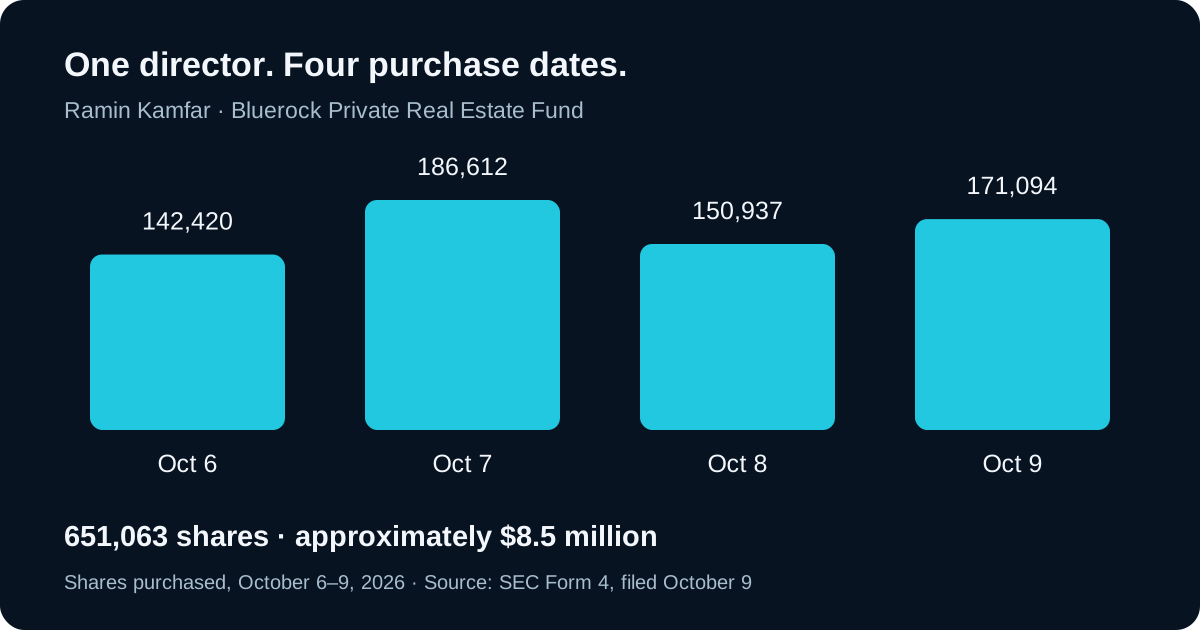
Ramin Kamfar, a director of Bluerock Private Real Estate Fund, reported buying 651,063 shares across October 6, 7, 8 and 9, 2026, for approximately $8.5 million. That sequence tells an investor more than an isolated purchase headline: the same person continued adding to his investment over several days.
TradingEdgeIQ’s Public Filings Intelligence alerts also brought attention to a broader group of related activity. The useful question is: who bought, how often, and which purchases are new? This case shows how answering those questions gives an investor a clearer starting point for research.
Previous in this research collection: The first $4.6 million was only the beginning. Nayax’s CEO kept buying..
Continue with: Medline: $722 million of selling, but how much remained?.
What Kamfar’s filing shows
The SEC Form 4 reports four purchase dates: 142,420 shares on October 6; 186,612 on October 7; 150,937 on October 8; and 171,094 on October 9.
Together, those rows total 651,063 shares. Multiplying each share quantity by its disclosed weighted-average price gives approximately $8.5 million of purchases.
The form’s filing date is October 9. Its SEC acceptance timestamp is 9:07:26 p.m. Eastern that evening, equivalent to October 10 at 01:07:26 UTC. The purchase dates describe when the transactions happened; the acceptance timestamp identifies when this disclosure became publicly available.
Repeated buying and independent buying answer different questions
Imagine one person buys on Monday, Tuesday, Wednesday and Thursday. That tells you the person kept adding to the investment.
Now imagine three independent people each buy. That adds another kind of information: several people have committed their own money.
Both patterns can deserve attention, but they support different observations. Kamfar’s four purchase dates establish repeated buying by that director. The number of rows alone does not establish four independent buying decisions by four different people.
Several names on a disclosure can also represent interests in the same purchase. The SEC’s Form 4 instructions allow beneficial owners to report transactions individually or jointly. Checking the people and ownership arrangements helps identify whose investment actually changed.
Why two alerts should not become two sets of purchases
Public Filings Intelligence grouped related Bluerock activity into research alerts. The earlier and later snapshots overlapped: some underlying purchases appeared in both.
Think of reading a running list of purchases today, then reading an updated list tomorrow. Tomorrow’s list can include purchases you already saw today. Adding both list totals would count that shared activity twice.
The later alert is useful because it directs attention back to the developing pattern. To understand what changed, compare the underlying purchases and buyers with the earlier snapshot.
That produces a much better research question than simply asking whether the alert’s number got larger: what was added, and did participation broaden?
How TradingEdgeIQ helps an investor
This is where Public Filings Intelligence can save research time. Its alerts help bring related activity to your attention, while the source disclosures let you examine the purchase dates, amounts and ownership details behind the pattern.
For Bluerock, the research starts with a concrete commitment: one director reported approximately $8.5 million of purchases over four days. The broader alerts then give you a reason to examine the surrounding activity and distinguish continued buying from additional independent participation.
With that evidence organized, you can investigate how the commitment fits with the fund’s holdings, liquidity, valuation and your own investment criteria. The purchases establish growing investment by the reported buyer; future returns remain a separate question to evaluate.
TradingEdgeIQ helps you find meaningful signals sooner, research them more thoroughly, and make better-informed investment decisions. Explore Public Filings Intelligence.
The pattern is the starting point
This case establishes three useful lessons: Kamfar added shares over four dates; repeated purchases and independent buyers provide different information; and overlapping alert snapshots should be compared before their totals are combined.
The next time a large purchase catches your attention, ask how that person’s investment changed and whether other independent people participated. And when another executive buys, ask the companion question: does participation in the buying broaden?
Previous in this research collection: The first $4.6 million was only the beginning. Nayax’s CEO kept buying..
Next research question: Medline: $722 million of selling, but how much remained?.
Image credit: Conceptual real-estate imagery generated for TradingEdgeIQ. It is not a photograph of a verified Bluerock property. Purchase quantities and dates come from the linked SEC filing.
Research and analytics only. No auto-trading. No financial advice. Historical and simulated results do not guarantee future performance.
Related