
Buffett's Berkshire added $349 million of Lennar. The sequence tells the story.
A weak quarter, six trading days of purchases and two public filings reveal why connecting the evidence is more useful than reading one headline.
Anuj Saxena · Founder, TradingEdgeIQ
Lennar reported a weaker quarter. Berkshire Hathaway began buying the next trading day and continued across six trading days, adding approximately $349 million of shares. The useful research signal emerges when those events are read together.
This article shows how the earnings release, transaction dates and successive disclosures turn a familiar-name headline into a focused research question. The preceding case, GameStop's six insider purchases, examined related buying across several people. Next, profitable on paper, fragile in reality applies the same evidence discipline to strategy results.
Situation: the business was under pressure
On September 16, Lennar reported quarterly net earnings of approximately $284 million, down from $591 million a year earlier. New orders fell 9%, deliveries fell 3%, and home-sales gross margin was 15.8%. Management described a deteriorating operating environment in its third-quarter results.
Those results establish the business backdrop. They do not tell us why another investor bought shares, but they make the subsequent accumulation worth examining: Berkshire increased its exposure while current operating performance was weak.
Complication: one disclosure showed only part of the buying
The first Form 4 reported purchases on September 17, 18 and 21. Multiplying each purchase row's share count by its reported weighted-average price produces approximately $212.4 million across Class A and Class B shares.
The SEC acceptance record places public disclosure at 9:31:10 p.m. Eastern on September 21. The buying began before this filing was public. Researchers could use the disclosed information after its release, not retrospectively on the first purchase date.
A September 22 market report described Lennar rising 5.6% in morning trading. That is an intraday observation, not a closing return or proof that the filing caused the entire move.
Berkshire then bought again. The second Form 4 reported September 23, 24 and 25 purchases worth approximately $136.4 million. Together, the two filings show 4,423,229 shares and approximately $348.8 million across six trading days. These are calculated gross purchase values, using rounded reported prices, rather than separately reported cash totals.
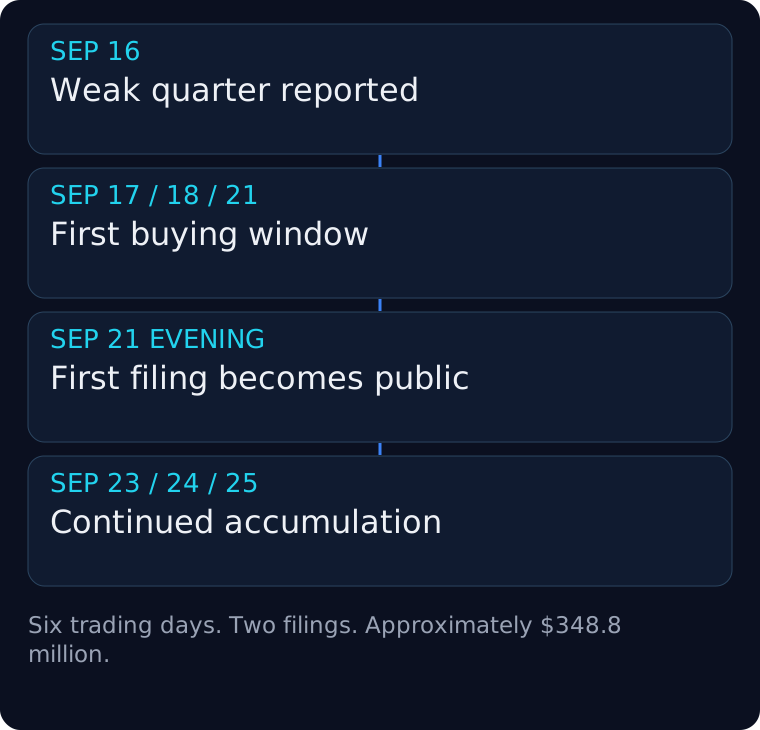
The second purchase window changes the research picture from one disclosed addition to continued accumulation. The diagram separates transaction dates from public disclosure and does not predict a return.
Question: what does the accumulation justify investigating?
The headline earns attention because Warren Buffett is closely associated with Berkshire. The forms name both Berkshire Hathaway and Warren E. Buffett as reporting persons. They do not establish that Buffett personally made this investment decision, and this case makes no such claim.
The research question is more specific than whether a famous investor bought: what could justify increasing exposure to a homebuilder after a weaker quarter? A useful review would examine affordability, order trends, incentives, margins and the company's response to current housing conditions. It would then test whether the investor's own valuation assumptions support a position.
Repeated buying supplies a reason to prioritize that review. It does not supply Berkshire's full investment thesis or erase the operating risks described in the earnings release. The combination of unfavorable current results and sustained accumulation is precisely the tension that makes this a worthwhile case.
Resolution: connect the records before forming a conclusion
Public Filings Intelligence brings reported transactions, ownership details, filing footnotes and original sources into a research workflow. That reduces the time spent locating forms and assembling their basic facts, leaving more time to evaluate the business question.
For this case, the useful working record preserves the weak quarter, both purchase windows and when each filing became public. The case-study chronology is our analysis of the source material; it is not a claim that TradingEdgeIQ sent a historical Lennar alert or automatically produced this entire narrative.
What this proved
Berkshire's approximately $349 million addition deserves attention because of its timing and persistence. Connecting two filings with the operating backdrop provides a stronger starting point for research than the latest transaction alone. A better-informed decision still requires an independent view of Lennar's business and valuation.
Return to GameStop's six insider purchases to compare buying across people with buying across time. Continue to profitable on paper, fragile in reality to examine another common shortcut: treating an attractive result as sufficient evidence.
Image credit
Cover: an AI-assisted editorial composite, not a photograph of Buffett visiting the homes. Warren Buffett portrait by Mark Hirschey, CC BY-SA 2.0; archival Tehaleh residential photograph by Chris Light, CC BY-SA 4.0. Adapted composite licensed CC BY-SA 4.0. Cropped and resized. No endorsement implied.
Research and analytics only. No auto-trading. No financial advice. Historical and simulated results do not guarantee future performance.
Related