Pampa Energy: a director adds $35.1 million during an oil expansion
A large personal share purchase arrives while Pampa expands oil production. The next question is whether growth can generate cash while the company manages its spending.
Anuj Saxena · Founder, TradingEdgeIQ
Pampa Energy is investing in more oil production. A director has also increased his own investment in the company. Those are two different money flows, but reading them together creates a useful research question.
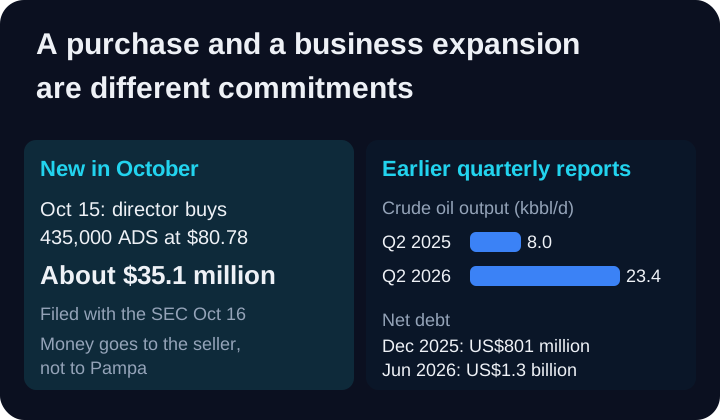
On October 15, 2026, Marcos Marcelo Mindlin bought 435,000 of Pampa's US-traded depositary shares at $80.78 each, approximately $35.1 million. The purchase was disclosed the next day.
This article connects that fresh filing with the company's expansion plans, while keeping clear what the purchase does and does not demonstrate.
Previous in this series: Borr Drilling: repeated buying during a difficult period.
Next in this series: GameStop: Ryan Cohen commits another $22.8 million.
The business behind the filing
Pampa is an Argentine energy company with oil, gas and electricity operations. Rincón de Aranda, a shale oil field, is an important part of its expansion.
In its August 4 second-quarter report, the company described new wells, processing facilities and pipelines. It reported crude oil production of 23.4 thousand barrels per day, compared with 8.0 thousand a year earlier. Its first-quarter release had already described rising shale oil output from the field as one contributor to higher sales.
These earlier company reports provide context. They are not newly announced October results, and the director's purchase does not prove that the expansion will succeed.
What Mindlin bought
The SEC transaction report records one purchase of 435,000 American depositary shares, commonly called ADS. An ADS is a US-traded certificate representing shares of a foreign company. For Pampa, one represents 25 ordinary shares.
That explains the security being reported. It is a supporting detail, rather than the reason the story matters. The main development is a director committing additional money while the business invests in growth.
Growth also consumes money
Buying existing shares does not send the purchase price to Pampa. The money goes to the seller. The purchase increases the buyer's exposure to the company's future performance; it does not directly finance the oil-field development.
The expansion has its own financing demands. Pampa reported net debt of about $1.3 billion in June 2026, compared with $801 million in December 2025. Net debt is borrowing minus cash. That makes spending and cash generation important parts of the research, alongside production growth.
What to follow
The useful test is practical. Does oil output keep growing? Can Pampa sell that production, manage development costs and turn growth into cash? Does its borrowing remain manageable as the project develops?
The filing does not explain Mindlin's motive or answer those questions. TradingEdgeIQ's Public Filings Intelligence solution helps bring significant disclosures into the research process; company reports supply the operating context.
The takeaway
A $35.1 million purchase is meaningful because it increases an insider's financial exposure during a substantial expansion. It provides a reason to investigate production, spending and cash generation together. It is not a substitute for that investigation.
Explore Public Filings Intelligence.
Previous in this series: Borr Drilling: repeated buying during a difficult period.
Next in this series: GameStop: Ryan Cohen commits another $22.8 million.
Research and analytics only. No auto-trading. No financial advice. Historical and simulated results do not guarantee future performance.
Image credit: Generated editorial illustration. It does not depict a Pampa Energy facility or transaction.
Research and analytics only. No auto-trading. No financial advice. Historical and simulated results do not guarantee future performance.
Related