
Two Accenture Leaders Bought. What Is the Bigger Question?
Two Accenture leaders acquired 13,000 shares. The filings sharpen an AI services research question without explaining their motives.
Anuj Saxena · Founder, TradingEdgeIQ
Two linked document cards represent the related filing trails. This is a stylized graphic, not an actual filing.
The filings sharpen the AI services growth debate.
Two Accenture leaders reported acquiring shares on the same day. Their filings make a useful research cluster, but they do not tell investors why either person bought or how much AI services will contribute to future earnings.
In this series: Kevin Hern’s three partial sales comes before this case. Next is NASA’s “Moonbase” Order: What Was Actually Bought?.
Two filings, one research lead
On October 26, 2026, chair and CEO Julie Sweet reported acquiring 12,200 Accenture shares. Director Paula Price reported acquiring 800 shares. Both Form 4 transaction tables code the shares as purchases and show increased direct holdings. Together, the filings show 13,000 shares acquired. Sweet Form 4; Price Form 4.
The price footnotes in the filings unexpectedly use the phrase “sale price.” The purchase codes and increased holdings support the acquisition count, but the wording conflict makes a combined dollar figure inappropriate for this case. It also rules out treating a quoted price as a clean measure of either leader’s cash outlay.
TradingEdgeIQ’s Public Filings Intelligence grouped the two disclosures and recorded a sent cluster notification. That connection is the product’s documented contribution: it brings related filings into one research lead. It does not establish the buyers’ motives or a likely stock move.
The business question remains open
Accenture’s fiscal results describe a broad consulting and technology services business. The filings make its AI services opportunity worth investigating, but do not isolate an AI revenue number or prove that demand will become durable profit. Accenture fiscal results.
An investor can use the cluster to organize the next review: how are bookings developing, what happens to margins as services change, how much are clients spending, and what valuation already reflects those expectations? Those are questions for operating disclosures and subsequent results.
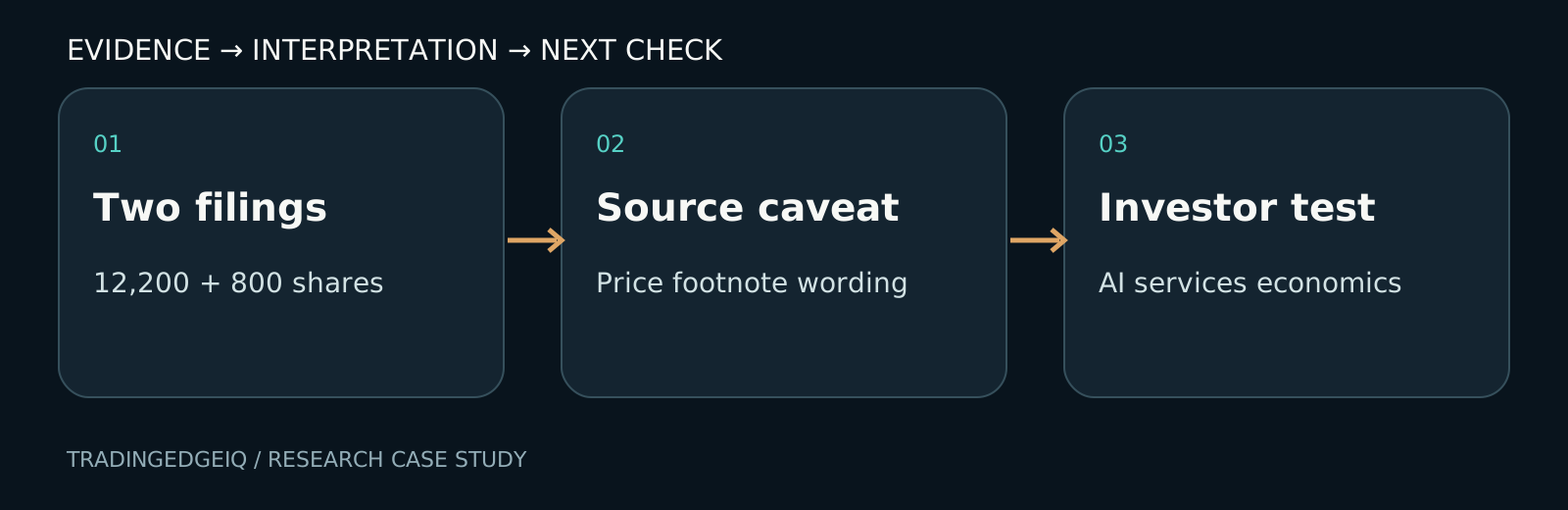
The two acquisitions form a research cluster; the price-footnote conflict and business economics still need separate scrutiny.
Three takeaways for traders and investors
- Connect related filings. Two independent acquisitions on the same date create a clearer research lead than either row alone.
- Keep the source caveat attached. The transaction tables support 13,000 shares acquired; the inconsistent price footnotes do not support a clean cash total here.
- Test the business thesis. Public Filings Intelligence helps prioritize the filings to read, while bookings, margins, client demand and valuation determine whether the investment case holds.
The useful signal is a documented cluster with a specific follow-up plan, not a conclusion about Accenture’s future share price.
Compare the account details in the Kevin Hern case, then continue to the NASA and Illinois Tool Works case, where a surprising award description calls for a different kind of verification.
Explore Public Filings Intelligence.
Research and analytics only. No auto-trading. Not financial advice. Evidence reviewed November 1, 2026.
Research and analytics only. No auto-trading. No financial advice. Historical and simulated results do not guarantee future performance.
Related